Global Low-Toxicity Heat Transfer Fluids for Renewables Market Set to Surge 2026–2036
Subscribe for Year-Round Insights → Stay ahead with quarterly and annual data updates: https://www.futuremarketinsights.com/reports/sample/rep-gb-30119
Market Drivers and Growth Dynamics
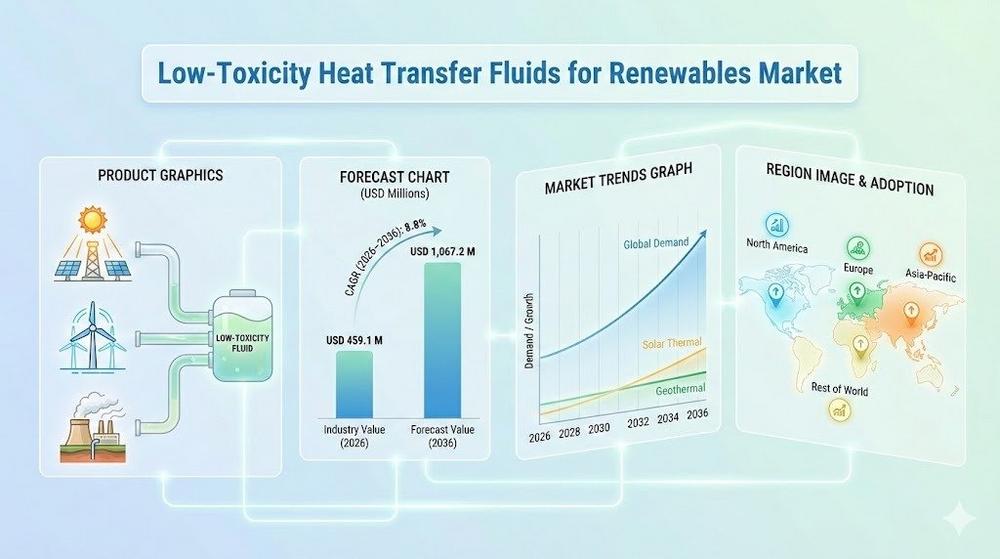
The global shift toward renewable energy has intensified the need for HTFs that combine high thermal efficiency with low environmental impact. Traditional fluids often pose hazards due to toxicity, volatility, and environmental risks. In contrast, low-toxicity HTFs—including bio-based/biodegradable synthetic esters and glycols—offer superior thermal performance while aligning with sustainability goals. These fluids currently lead the market with a 28% share, largely due to their biodegradability and compatibility with high-temperature renewable applications.
As renewable installations increase worldwide, particularly in solar and geothermal energy, operators are prioritizing HTFs that enhance system longevity, reduce environmental risks, and comply with evolving regulations. Innovations in fluid formulations now provide improved thermal stability, reduced freezing points, and extended operational life, making them increasingly competitive with conventional fluids.
Segment-Wise Market Analysis
Fluid Chemistry:
- Bio-based / Biodegradable Synthetic Esters & Glycols: 28% market share, preferred for CSP and thermal storage due to safety and high heat transfer efficiency.
- Other Fluids: Low-toxicity silicone HTFs, mineral oil replacements, ionic liquids & deep eutectic solvents, and water-based HTFs also contribute to the growing demand.
Renewable Applications:
- CSP & Thermal Storage: Largest application segment with a 34% share. Efficient heat storage and transfer are critical for reliable solar energy production.
- Solar Process Heat & District Heating Systems, Geothermal Heat Transfer Loops, and Biomass & Bioenergy Systems follow, reflecting the market’s broad renewable application.
Regional Insights
- China: Leading growth at 11.5% CAGR due to rapid solar and geothermal adoption and sustainability initiatives.
- Spain: 10% CAGR, supported by large-scale solar energy projects and renewable policies.
- United States: 9% CAGR, fueled by government incentives and private investment in clean energy infrastructure.
- Germany: 8.5% CAGR, benefiting from stringent environmental regulations and robust renewable energy programs.
Competitive Landscape
Key players are focusing on sustainable formulations and regulatory compliance to differentiate themselves:
- Therminol / Eastman: Emphasizes broad temperature range, thermal stability, and eco-friendly formulations.
- Globaltherm: Highlights high-performance, low-hazard fluids with clear safety documentation.
- BASF: Offers diverse chemistries suitable for multiple renewable applications, emphasizing lifecycle benefits and regulatory alignment.
Across the market, competitors stress sustainability, safety, and operational efficiency to drive adoption. Collaboration with renewable system designers ensures fluids meet specific performance criteria while complying with environmental standards.
Market Trends
- Development of fully biodegradable, low-freezing-point fluids for extreme conditions.
- Growing collaboration between fluid manufacturers and renewable system operators for optimized formulations.
- Increased regulatory alignment, green certifications, and sustainability-driven adoption.
Challenges and Adoption Barriers
Despite strong growth, adoption faces challenges:
- Higher Upfront Costs: Specialized low-toxicity fluids may be more expensive than traditional HTFs.
- Performance Validation: Operators require assurance that greener fluids meet efficiency and longevity standards.
- System Compatibility: Existing infrastructure may require engineering adjustments for certain low-toxicity fluids.
Growth Outlook
The market is poised for robust growth through 2036, driven by:
- Expansion of CSP, geothermal, and biomass systems globally.
- Rising environmental awareness and regulatory pressures.
- Technological innovations improving fluid performance, stability, and environmental safety.
Get data that aligns with your strategic priorities — ask for report customization today: https://www.futuremarketinsights.com/customization-available/rep-gb-30119
Related Reports:
Transformer Monitoring System Market – https://www.futuremarketinsights.com/reports/transformer-monitoring-system-market
Sulphur Recovery Technology Market – https://www.futuremarketinsights.com/reports/sulphur-recovery-technology-market
Marine Fuel Injection System Market – https://www.futuremarketinsights.com/reports/marine-fuel-injection-system-market
Have a specific Requirements and Need Assistant on Report Pricing or Limited Budget please contact us – sales@futuremarketinsights.com
Future Market Insights, Inc. (FMI) is an ESOMAR-certified, ISO 9001:2015 market research and consulting organization, trusted by Fortune 500 clients and global enterprises. With operations in the U.S., UK, India, and Dubai, FMI provides data-backed insights and strategic intelligence across 30+ industries and 1200 markets worldwide.
Future Market Insights, Inc
Christiana Corporate, 200 Continental Drive, Suite 401,
USADelaware Newark,
Telefon: +1-347-918-3531
Telefax: +1 845 5795705
http://www.futuremarketinsights.com
Marketing
Telefon: +13479183531
E-Mail: Rahul.Singh@futuremarketinsights.com