Waste Prevention: The Collision of Ambition, Reality, and Growth Pressure
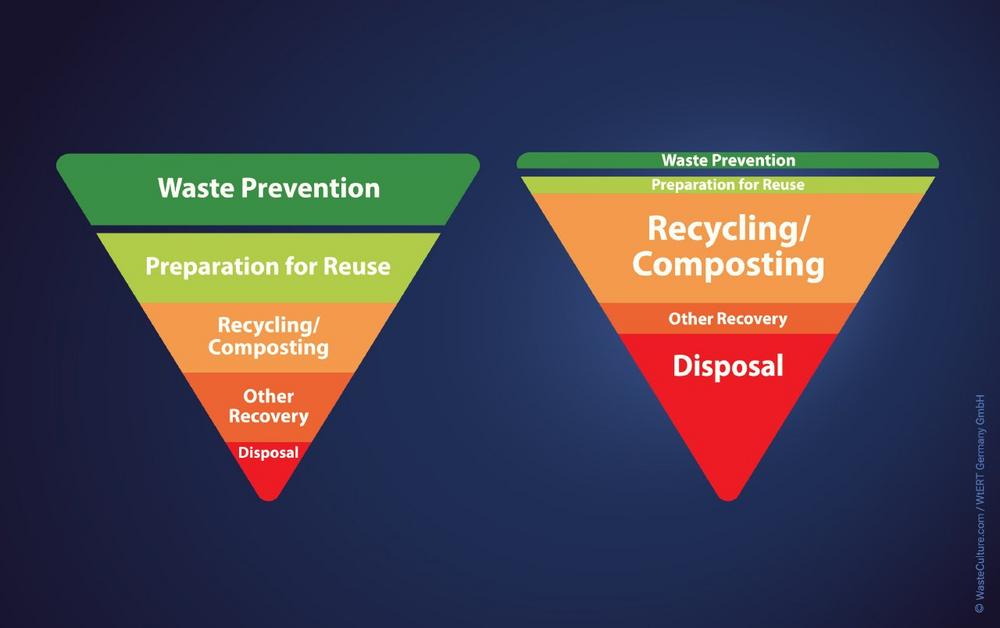
The European Union places waste prevention at the top of its waste management hierarchy, placing it above all recycling measures. Even the Circular Economy Action Plan (2020), the central instrument of the European Green Deal, cites “less waste” as its primary goal. The Green Deal demands that manufacturers produce durable, repairable, and recyclable products. Although waste prevention is only legally enshrined within the EU – first introduced in the Council Directive 75/442/EEC of July 15, 1975, on waste – this guiding principle has great international appeal. The ‚Global Waste Management Outlook 2024‘ report from the UN Environment Programme (UNEP) shows that the directive has had little effect so far, and forecasts a rise in municipal waste, from 2.1 billion tonnes in 2023 to 3.8 billion tonnes by 2050.
This trend is also continuing unabated across Europe: The EU’s average municipal waste production now exceeds 500 kilograms per person per year; in the USA it is almost twice as high. Countries in the Global South produce significantly less waste, however this is due to lower purchasing power, not to more successful waste prevention. Thus it is apparent: As prosperity and consumption increase, so does the amount of waste produced. Waste prevention must therefore be a priority in affluent societies, and consumer cultures must be critically examined.
Structural causes instead of moral appeals
Public discourse often portrays waste prevention as an individual responsibility: Consume more mindfully, throw away less and act more sustainably! However, this perspective is not sufficient. The main drivers of waste production – short product lifecycles, overproduction, excessive packaging and marketing-driven consumption – are systemic factors and so far inadequately addressed politically. Although the European Commission has, for example, been regulating packaging since 1994, packaging waste continues to increase. This shows that individual political incentives are not enough, if economic incentives are geared towards growth rather than reduction.
The growth dilemma
Europe, like many regions of the world, faces a fundamental contradiction:
Consistent waste prevention inevitably results in lower production and reduced consumption. Economic growth, however, is dependent on the ongoing production of goods that ultimately become waste at the end of their life cycle.
As long as economic growth is considered an indispensable political objective, waste prevention strategies will remain caught between conflicting objectives. Some companies are subsidised by the state as engines of economic growth, while at the same time citizens are expected to reduce waste through their behaviour. This shift in responsibility overburdens individuals and leaves structural levers untouched.
Waste prevention requires structural responsibility
Effective waste prevention can only be achieved if industry and trade are subject to binding regulations and if overproduction, short-lived products and hazardous products are limited, and responsibility for waste prevention is fairly distributed among all stakeholders.
Werner Bauer, founder of the WasteCulture.com platform, emphasises: ‘At the latest when the consumption of resources associated with economic growth reaches its natural limits, responsible policymakers will have no choice but to critically question growth targets and combine them with a comprehensive circular economy.’
President von der Leyen’s State of the Union address 2025 on September 10, 2025, makes this clear. The ‘transformation [of the EU’s industry] is central to our push for independence. Because it reduces our energy dependency. Because circular production limits our strategic dependencies’. However, sufficiency and reduced consumption are not mentioned.
WasteCulture proposes the intense promotion of waste prevention, while drawing a clear distinction between product policy and changes in consumer behaviour. Products designed for short-term use and rapid disposal, such as single-use vapes or nitrous oxide cartridges, must be addressed through clear regulatory instruments, such as deposit systems, or, better still, should not be produced in the first place.
Demanding behavioural change from citizens while simultaneously flooding the market with non-recyclable and therefore unsustainable products places an unreasonable burden on individuals.
Expertise for real solutions
The global knowledge platform WasteCulture.com presents a wide range of sustainable solutions for municipal, national and global waste management in numerous case studies. While individual measures taken by local authorities or private individuals, as well as isolated examples from industry, are highly significant, they cannot solve the waste problem on their own. Despite the growing global population, sustainable waste management must always be measured in terms of reducing the impact on the environment — above all through a significant reduction in greenhouse gas emissions and plastic pollution in the world’s oceans — rather than on the total volume of waste generated.
WasteCulture is an independent knowledge brand and B2B platform fostering a global circular waste culture. Since 2017, it has connected over 5,000 international experts to share best practices, research, and insights. Operated by WtERT Germany GmbH, the platform promotes dialogue among waste management stakeholders — including scientists, industry representatives and policymakers — to advance sustainable waste management worldwide.
WasteCulture
Lipowskystraße 8
81373 München (Munich)
Telefon: +49 (89) 1891787-16
Telefax: +49 (89) 1891787-29
https://wasteculture.com
Project Management
E-Mail: s.loeber@wasteculture.com