Beyond Traditional Transfer Machines: Integration and Control in a Large-Scale Machine Designed for the Automotive Industry
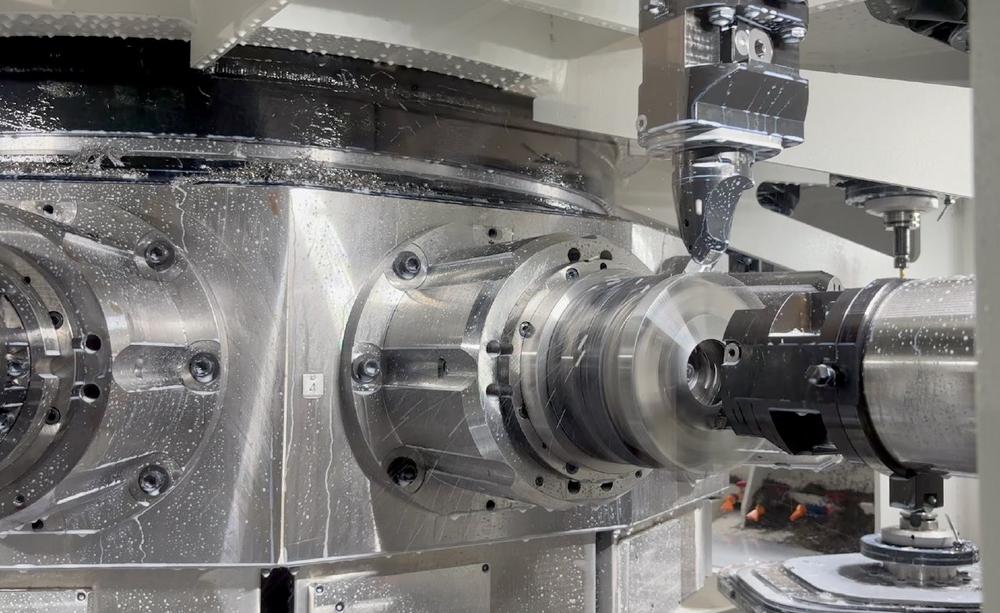
The growing complexity of machining in the automotive sector, particularly for components related to electrification, is putting pressure on traditional production models, especially when it comes to managing multiple processes simultaneously and in a controlled manner. It is in this context that the long-standing collaboration between NUM and Spada Machines — a Brescia-based company specializing in the design and manufacture of transfer machines, multi-spindle turning centers, and special-purpose machines — reaches one of its most advanced milestones: the development of a transfer machine for a German automotive customer, characterized by a level of integration and process density far exceeding industry standards.
“The main challenge of this project was not only to increase the number of machining operations, but to manage them in a coherent manner,” emphasizes Marco Battistotti, Managing Director of NUM Italy. “This machine is, in fact, among the most sophisticated NUM has ever worked on, and the numbers clearly highlight its complexity: 66 controlled axes, 26 spindles in total, and the ability to manage up to 40 simultaneous machining processes.”
A Different Approach
Spada Machines operates in this landscape with a positioning that breaks away from the established norms of transfer technology. With a history dating back to the 1960s, the company has in fact chosen not to compete on standard configurations — vertical or horizontal — but to develop proprietary solutions built around customers’ application needs. “When we started, we clearly understood that we couldn’t compete with those already dominating those segments,” says Mauro Guerra, CEO of Spada Machines; “we had to offer something different.”
This approach gave rise to the patented Multi-S technology, based on a multi-station structure capable of integrating turning and milling operations — even simultaneously — concentrating multiple operations into a single setup. This setup allows the machine to overcome the traditional limitations of transfer machines and handle components that differ in material, geometry, and dimensions within the same system, while maintaining high levels of precision and process stability. Throughout this journey, the collaboration with NUM has been crucial from the earliest stages of technology development, contributing substantially to the definition of the control architecture and application solutions.
Flexibility, Efficiency, and Precision
This level of integration finds its fullest expression in the machine developed for a German automotive industry client, where transfer technology is pushed to a degree of integration and process density rarely found in traditional configurations.
“The machine we developed,” explains Battistotti, “features 66 controlled axes, a total of 26 spindles — 13 of which are closed-loop controlled and 13 open-loop — and has the capacity to handle up to 40 simultaneous machining operations, equivalent to that many part programs running in parallel. But the critical issue is not merely the parallel execution of the programs, but rather their synchronization, because the machine’s overall efficiency depends on this coordination.”
The structure is based on a multi-station architecture — up to 12 operational stations — in which each unit can be reconfigured according to the cycle: a spindle can be transformed into a C-axis or a milling unit, switching from turning operations to milling operations within the same process. This flexibility generates a very high number of operational combinations and allows multiple production phases to be concentrated into a single system.
“This versatility,” emphasizes Mattia Spada, Project Manager at Spada Machines, “is complemented by a mechanical design focused on stability. The machine must, in fact, withstand heavy material removal in the first stations while simultaneously ensuring high precision during finishing operations. The base- s and the structure are therefore designed to isolate vibrations and prevent the stresses generated during the heaviest machining operations from being transmitted to subsequent stations, preserving the quality of the part and the repeatability of the process.”
Technological Partnership
In this context, NUM’s contribution goes far beyond simply supplying the numerical control system, extending directly into the definition of the machine’s mechatronic architecture. The system is based on a configuration with 5 modular NCKs, designed to coordinate the management of the high number of active axes and processes, and on a single centralized PLC — a choice that goes against the trend of multi-PLC architectures, simplifying management by enabling unified control of all machine functions and avoiding the need to synchronize separate logic systems.
“This architecture is complemented by full integration of certified safety functions,” adds Spada, “distributed across all axes and spindles but managed by a centralized system, as well as a drive system based on DSL technology, which drastically reduces cabling by using a single cable for power and feedback. In a system with 66 axes, this choice has a significant impact on the machine’s design and industrialization, making it more compact and efficient.”
Rounding out NUM’s technological contribution is the adoption of liquid-cooled synchronous spindles, an uncommon solution in the world of transfer machines. “Unlike traditional systems based on asynchronous motors,” Battistotti explains, “these spindles are direct-drive, with no intermediate kinematics, and operate in line with the motor, while liquid cooling maintains a constant operating temperature and thus dimensional stability.” The result is greater precision over time, accompanied by high dynamic performance.
Efficiency over time
Rounding out the picture is the ability to translate this architecture into real operational continuity, where the key parameter is not theoretical speed but efficiency over time. The system integrates advanced monitoring functions that allow for real-time process control and the detection of any anomalies before they result in scrap or machine downtime — a crucial aspect in a transfer press where multiple parts are processed simultaneously. “Better to add a second to the cycle time but achieve a higher and more consistent level of efficiency,” Guerra notes, “because stability is what determines overall productivity.”
At the same time, energy management based on modular drives with grid-feedback allows for the reuse of energy generated during deceleration phases, improving the overall efficiency of a system characterized by high installed power. The result is a platform that, while developed for a specific application in the electric automotive sector, demonstrates clear industrial scalability.
NUM AG
Battenhusstrasse 16
CH9053 Teufen
Telefon: +41 71 335 04 11
Telefax: +41 71 333 35 87
https://www.num.com/
Marketing Communication Manager
Telefon: +41 (71) 33504-35
E-Mail: larissa.kuehne@num.com


Das könnte dich ebenfalls interessieren

IMA Schelling Consulting unterstützt bei Investitions- und Werksentwicklungsplanung
BBG Produktionsanlagen für Polyurethan und Keramik à la carte: Komplettlösungen und Sondermaschinen