
New Global ADS Regulations: Why the Control Layer Is Becoming a Key Technology for Software-Defined Vehicles
The combination of two instruments is crucial. UN R185 is associated with the 1958 Convention and provides a framework for type approval by contracting parties that apply the regulation. UN GTR 26 is part of the 1998 Convention and establishes a globally harmonized technical foundation that must be transposed into national or regional regulations. Consequently, this does not automatically result in identical registration laws worldwide. However, it does establish a common technical standard—and thus a significantly more robust foundation for development, safety justification, and international scaling.
The 21st session of the UNECE Working Group on Automated Driving Systems (ADS) continued its work on the Guidance and Interpretation Documents (GID) for UN R185 and UN GTR No. 26. This underscores that the implementation of the new ADS regulations is accompanied by supplementary guidelines and interpretive aids. The meeting underscores that regulation is not a static endpoint, but rather an ongoing process involving requirements, interpretation, verification, and operation.
What Changes with the New ADS Regulations
Until now, the safety of automated driving functions was often assessed based on individual functions, defined scenarios, or limited use cases. The new framework shifts the perspective: It is not a single passed test that determines safety, but rather the totality of evidence with which a manufacturer demonstrates the safety of its ADS and maintains it throughout the lifecycle.
- Safety Management: Responsibilities, processes, and controls must be traceable from development and the supply chain all the way through to operation.
- Safety Case: Safety claims require structured reasoning and robust evidence rather than isolated test results.
- Multi-layered validation: Audits, analysis, simulation, test tracks, and real-world operation complement each other to form a comprehensive picture.
- Operational Design Domain: The system must clearly master its intended operating conditions and limits.
- In-Service Monitoring and Reporting: Safety does not end with the start of production; field data, events, and changes become part of the ongoing assessment.
- Traceable System Responses: Critical states, degradation, minimal-risk behavior, and relevant events must be technically controlled and documentable.
- DSSAD data logging remains relevant as a component of the regulatory framework.
Autonomy Requires More Than Perception and Artificial Intelligence
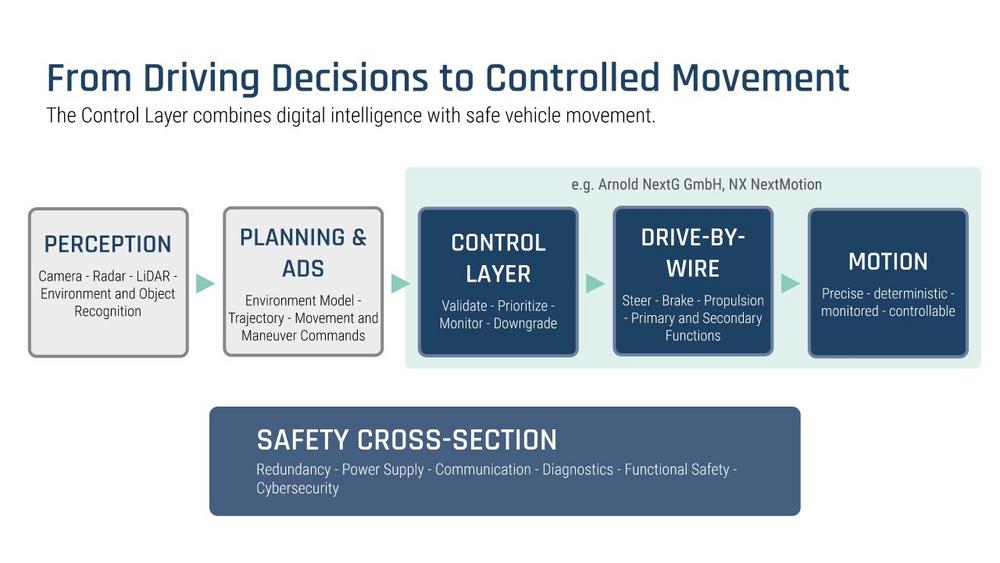
The public discussion about autonomous driving usually begins with cameras, radar, LiDAR, and artificial intelligence. These systems sense the environment, build a world model, and plan a trajectory. This is indispensable—but it does not yet constitute vehicle movement.
Between the digital driving decision and the vehicle’s physical response lies a safety-critical chain: A command must be validated, prioritized, processed in a timely manner, transmitted to the appropriate actuators, continuously monitored, and handled in a controlled manner in the event of deviations. If a sensor becomes inconsistent, a communication path fails, or an actuator loses power, the system must not merely report an error. It must remain capable of acting and controllable within the safety concept.
It is precisely at this point that software translates into an actual steering movement, braking deceleration, or drive torque. This is where digital intelligence meets physics—and this is where it is determined whether the entire safety case holds up.
The Control Layer: A Clear Division of Responsibility Between Decision-Making and Motion
The new UN regulations do not use the term “Control Layer.” Arnold NextG employs it as an architectural designation for the layer between driving decisions and actuators. This distinction is strategically important because it clarifies a responsibility that is often vague: Who ensures that a driving command—regardless of its source—is implemented correctly, prioritized, monitored, and in a fault-tolerant manner?
A robust Control Layer establishes a defined system boundary for this purpose. It does not take over perception of the environment and does not replace the AD stack. It ensures that the AD stack’s setpoints are translated into a controlled vehicle response. At the same time, it can integrate additional control sources—such as teleoperation or driver interaction—into the same safety architecture.
Conclusion
The new ADS regulations do not prescribe a specific system architecture. However, they make it clear that, in the future, safety must be demonstrated across the entire chain of effects of an automated driving system. This brings the layer between driving decisions and vehicle movement into sharper focus.
Arnold NextG refers to this level as the Control Layer. It links digital driving decisions with their safe and controlled implementation in the vehicle, thereby establishing a clearly defined division of responsibility between the AD stack and the actuators.
We Control what moves!
In the second part of this series, we examine the technical requirements for a Control Layer and demonstrate why drive-by-wire is becoming the central enabling technology for future vehicle architectures.
Sources and Regulatory Note
This classification takes into account the status of the published results from the 21st ADS session of the UNECE held July 14–17, 2026. It represents a technical and strategic assessment by Arnold NextG and does not constitute legal or homologation advice.
UNECE: Announcement on the new global ADS regulations
UNECE ADS IWG: 21st Session, Brussels, July 14–17, 2026
- Arnold NextG: NX NextMotion
- Arnold NextG: Safety Concept
- Arnold NextG: Certificates
- Arnold NextG: Company and Mission
Weitere Informationen unter www.arnoldnextg.com/blog
Arnold NextG realizes the safety-by-wire® technology of tomorrow: The multi-redundant central control unit NX NextMotion enables a fail-operational and individual implementation, independent of the vehicle platform and unique worldwide. The system can be used to safely implement autonomous vehicle concepts in accordance with the latest hardware, software and safety standards, as well as remote control, teleoperation or platooning solutions. As an independent pre-developer, incubator and system supplier, Arnold NextG takes care of planning and implementation – from vision to road approval. With the road approval of NX NextMotion, we are setting the global drive-by-wire standard. www.arnoldnextg.com
Arnold NextG GmbH
Breite 3
72539 Pfronstetten-Aichelau
Telefon: +49 171 5340377
http://www.arnoldnextg.de
Pressesprecherin
E-Mail: anke.leuschke@arnoldnextg.de


Das könnte dich ebenfalls interessieren

Der neue Lexus RX
Erneut den „Jackpot“ geknackt