
Demand for Nano Bubble Generators in the USA grows as utilities and industries seek efficient water solutions (2026–2036)
Market outlook highlights a decade of steady, efficiency-led growth
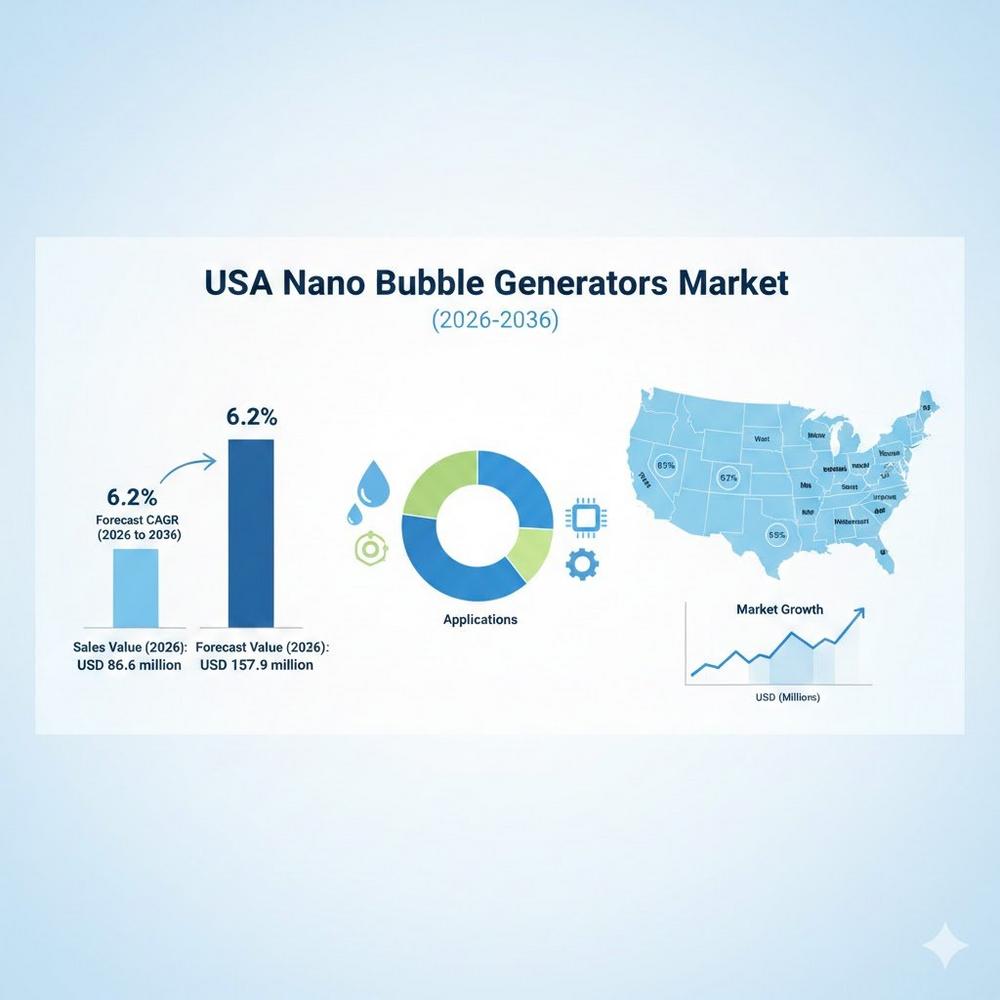
The Demand for nano bubble generators in the USA is valued at USD 86.6 million in 2026 and is projected to reach USD 157.9 million by 2036, expanding at a 6.2% CAGR over the period. Growth is anchored in the need to improve water and process efficiency without proportionally increasing energy or chemical inputs.
Nano bubble technology produces ultra-fine gas bubbles that remain stable in water for extended periods, significantly improving dissolved gas transfer. This performance advantage positions the technology as a practical upgrade for wastewater aeration, irrigation systems, aquaculture ponds, and industrial cleaning processes. As sustainability targets tighten across US states, utilities and operators increasingly view nano bubbles as a lifecycle-cost optimization tool rather than an experimental solution.
Subscribe for Year-Round Insights → Stay ahead with quarterly and annual data updates: https://www.futuremarketinsights.com/reports/sample/rep-gb-29964
Water treatment remains the anchor application
Water treatment represents 25.0% of total US demand, making it the largest application segment. Municipal and industrial wastewater operators deploy nano bubble generators to enhance dissolved oxygen levels, accelerate biological treatment, and reduce aeration energy consumption.
By improving oxidation efficiency and stabilizing oxygen delivery, nano bubbles allow plants to lower chemical dosing and improve treatment consistency. Utilities in water-stressed regions are also evaluating the technology for water reuse, tertiary treatment, and odor control, aligning operational performance with regulatory and environmental mandates.
Gas–water circulation systems dominate product adoption
Gas–water circulation type systems account for 56.0% of US demand, making them the leading product category. These systems recirculate gas and water to generate consistently sized nano bubbles with high dissolution rates and lower energy requirements.
Their design simplicity supports scalability across municipal treatment plants, large irrigation networks, aquaculture facilities, and industrial process loops. Compared with pressurized dissolution systems—which serve compact or niche installations—circulation-based designs offer operational stability, easier maintenance, and reliable performance in continuous-use environments.
Key advantages driving adoption include:
- Stable nano-scale bubble generation
- Uniform gas dispersion for oxidation and biofilm control
- Lower lifecycle maintenance complexity
- Compatibility with existing water infrastructure
Gas-injection technology leads by efficiency and adaptability
By technology, gas-injection nano bubble systems hold a 33.0% share, reflecting strong demand for controllable and energy-efficient gas delivery. These systems inject air, oxygen, or ozone directly into liquid streams, supporting precise concentration control across diverse applications.
Electrolysis-based systems serve applications requiring reactive gas species, while cavitation, membrane, and plasma technologies address specialized industrial, medical, or research needs. Overall, gas-injection methods dominate because they balance performance, energy efficiency, and ease of integration within regulated US operational settings.
Regional demand reflects water stress and infrastructure priorities
Demand growth varies by region, shaped by water availability, regulatory pressure, and industrial activity.
- West USA (7.1% CAGR): Leads national growth due to water scarcity, water reuse initiatives, desalination pretreatment, and precision agriculture. Utilities and farms favor advanced, sensor-integrated systems that reduce chemical use and improve efficiency.
- South USA (6.4% CAGR): Driven by large-scale agriculture, aquaculture expansion, and wastewater treatment upgrades. Warm climates increase demand for robust systems capable of continuous operation and effective oxygen stabilization.
- Northeast USA (5.7% CAGR): Adoption is influenced by regulatory compliance, infrastructure modernization, and industrial process optimization, with strong emphasis on pilot validation and certified performance.
- Midwest USA (4.9% CAGR): Growth remains steady, supported by agriculture, food processing, and biofuel wastewater treatment, with buyers prioritizing modular and cost-effective installations.
Adoption drivers balanced by validation and cost considerations
US demand is propelled by the need to improve oxygen transfer efficiency, reduce chemical intensity, and enhance biological treatment outcomes. Agriculture operations use nano bubbles to improve nutrient uptake and root oxygenation, while aquaculture facilities stabilize dissolved oxygen in high-density environments. Industrial users apply the technology in flotation, surface cleaning, and separation processes.
However, adoption is moderated by upfront capital costs, site-specific performance validation requirements, and the absence of standardized performance metrics. Smaller municipalities and farms remain cautious, requiring clear lifecycle cost benefits and documented case studies before large-scale deployment.
Get data that aligns with your strategic priorities — ask for report customization today: https://www.futuremarketinsights.com/customization-available/rep-gb-29964
Competitive landscape emphasizes reliability and support
The US market is shaped by suppliers with proven installation track records and strong application engineering capabilities. Moleaer, Nanobubble Solutions Inc., AquaPro Solutions, Nikuni America, and Atlas Copco lead demand through system efficiency improvements, scalable designs, and integration with existing water and process infrastructure.
Buyers prioritize vendors offering domestic service support, compliance with US standards, and demonstrable energy and chemical savings. As more utility-scale and industrial case studies emerge, nano bubble generators are expected to transition from targeted efficiency upgrades to mainstream components of US water and process optimization strategies.
Related Reports
Stair Lift Motors Market – https://www.futuremarketinsights.com/reports/stair-lift-motors-market
Plate Heat Exchanger Market – https://www.futuremarketinsights.com/reports/plate-heat-exchanger-market
Solar Inverter Market – https://www.futuremarketinsights.com/reports/solar-inverter-market
Have a specific Requirements and Need Assistant on Report Pricing or Limited Budget please contact us – sales@futuremarketinsights.com
Future Market Insights, Inc. (FMI) is an ESOMAR-certified, ISO 9001:2015 market research and consulting organization, trusted by Fortune 500 clients and global enterprises. With operations in the U.S., UK, India, and Dubai, FMI provides data-backed insights and strategic intelligence across 30+ industries and 1200 markets worldwide.
Future Market Insights, Inc
Christiana Corporate, 200 Continental Drive, Suite 401,
USADelaware Newark,
Telefon: +1-347-918-3531
Telefax: +1 845 5795705
http://www.futuremarketinsights.com
Marketing
Telefon: +13479183531
E-Mail: Rahul.Singh@futuremarketinsights.com