The WearHealth AI Ergonomics Coach: Behavior-based ergonomics for measurable reduction of injuries and absenteeism
Hall 7, Booth A06
Musculoskeletal disorders as a structural risk in industry and logistics
Musculoskeletal disorders (MSDs) are the leading cause of work-related injuries and absenteeism in industrial and logistics environments. They primarily affect the back and shoulders and represent the single largest driver of lost workdays across physically demanding industries.
The root causes are rarely isolated extreme loads. Instead, MSDs develop through repetitive tasks, poor posture, and the absence of immediate feedback during daily work activities. These risks are further amplified by an aging workforce, ongoing labor shortages, and increasing employee turnover—placing additional pressure on productivity, operational costs, and workforce stability.
Why traditional ergonomics measures fail to change behavior
Training programs and one-off ergonomic interventions may increase awareness, but they rarely lead to sustained behavior change on the shop floor. Ergonomic risks typically occur during routine work, under time pressure, or in complex situations—exactly when learned knowledge is difficult to recall without real-time feedback.
Without continuous feedback at the moment of movement, employees quickly revert to established movement patterns. Isolated assessments and occasional observations provide only snapshots of reality and do not support day-to-day behavior in the work process.
The result is clear: ergonomic risks persist, absenteeism continues to rise, and prevention remains largely reactive instead of proactive.
The WearHealth AI Ergonomics Coach – Real-Time feedback that drives behavior change at work
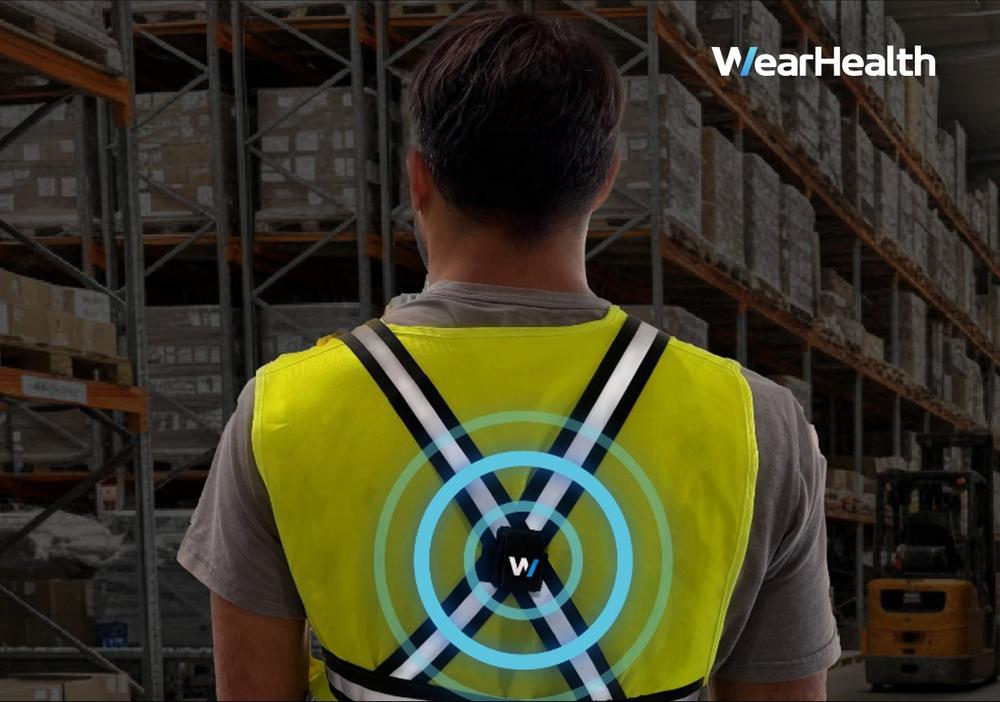
The WearHealth AI Ergonomics Coach directly addresses this gap. The solution combines a lightweight, unobtrusive wearable with an AI-based analytics platform. The wearable is worn on the back or shoulder and continuously captures movement data during regular work activities.
Using artificial intelligence, the system identifies ergonomically risky movement patterns in real time. When unsafe posture or movement is detected, employees receive immediate feedback via vibration or sound, enabling correction at the exact moment the movement occurs.
Ergonomic behavior is not taught theoretically—it is trained continuously through real-time coaching and gradually becomes automated.
Continuous feedback initiates a learning process that leads to long-term behavior change. Employees develop greater body awareness and progressively integrate healthier movement patterns into their daily routines.
This approach transforms ergonomics from isolated interventions into a continuous, behavior-based prevention strategy embedded directly in everyday work.
Up to 78% risk reduction within 3 months
Real-world deployments show clear and quantifiable impact:
- Up to 78% reduction in ergonomic risk within approximately three months
- Significant decrease in cumulative musculoskeletal strain
- Sustainable improvement of real movement patterns
- Up to 230% return on investment (ROI)
Ergonomics becomes objectively measurable, time-based, and scalable across operations.
Employee acceptance as a critical success factor
Behavior-based prevention is only effective when employees accept it. The WearHealth AI Ergonomics Coach is intentionally designed to be lightweight, comfortable, and unobtrusive. There is no personal tracking, no performance evaluation, and no individual monitoring.
In practice, 80% of the workers actively recommend the AI Ergonomics Coach. Users report fewer physical complaints at the end of their shifts and a noticeable reduction in daily strain—key indicators of sustainable adoption.
Data-driven insights for organizations – Anonymous, Scalable, and GDPR-Compliant
In parallel with individual coaching, organizations receive anonymized and aggregated insights through AI dashboards, including:
- Clear ergonomic risk analyses
- Objective decision-making data for prevention strategies
- Compliance reports aligned with international standards
All data processing is fully GDPR-compliant and does not allow conclusions about individual employees. The solution scales easily—from single teams to entire sites and global operations.
Visit https://www.wearhealth.com for more information.
WearHealth GmbH
Fahrenheitstraße 1
28359 Bremen
https://www.wearhealth.com
E-Mail: susanne@wearhealth.com


Das könnte dich ebenfalls interessieren
Sievert erweitert Flächen im niederländischen Hardenberg
Die Zukunft der Logistik in Zeiten unsicherer Lieferketten