
A recipe for success
How do you check the quality of 4,000 rusk slices leaving a 200-meter-long oven line on a four-meter-wide conveyor belt every minute? You employ a staff of five, each with a keen eye and quick reactions who, for example, sort out slices that are too dark or lying on top of each other. That’s how Bolletje in Almelo, Netherlands, did it for many years.
Or you can use a compact robot cell consisting of a camera, a four-axis Stäubli robot, and an AI-based IT platform. Bolletje has been using this new concept for several months now – and is completely satisfied with it.
Investing in automated quality control
“We supply retail chains and are under high price and competitive pressures. At the same time, as a premium manufacturer, we set high quality standards for our products, and so do consumers. We can achieve both goals by automating inspection at the end of the oven line,” says Lo Huls, COO of Bolletje.
The company made contact with the solution’s supplier at a food industry event. As Lo Huls explains, “A colleague reported on a presentation about a very powerful product inspection system that uses robotics and vision AI, and suggested we take a closer look. QING Food Automation then presented this concept to us here, and we implemented it on one of our 15 oven lines.”
A compact and lean concept
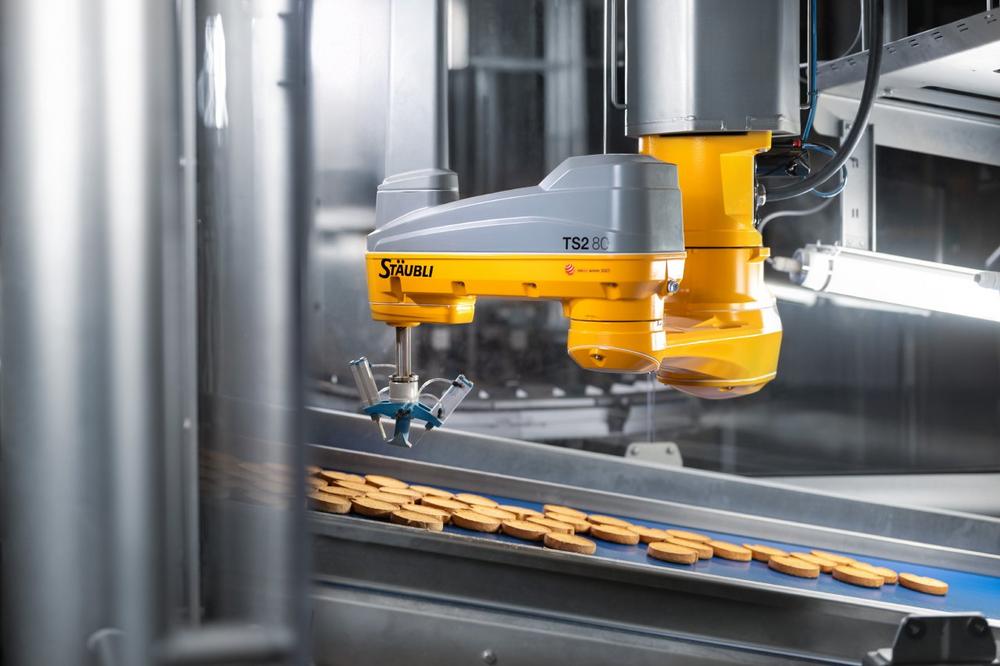
One of the special features of this solution is that it can be deployed in a very small space. The cell occupies an area of just 1.8 m x 3.2 m. The rusk slices are captured by a camera, the images are evaluated within milliseconds, and the Stäubli robot places the N.i.O. rusks on belts running to the right and left of the main conveyor belt. After a further conveyor section, the rusks are immediately packaged in the typical 140g units.
The compactness of the cell not only has the advantage of being easily integrated into existing lines, but as Lo Huls points out, “We can, and will, dismantle the system very quickly if necessary and install it on another oven line if, for example, the reject rate is higher there.”
AI-supported automation under special conditions
What QING Food Automation has achieved here (and in other applications, such as quality control for peaches) is already widespread in other industries, such as metal processing. Why not in food production? According to Bram de Vrught, Managing Director at QING, “In the food industry, and not only in industrial bakeries, we see a lot of variation. Each individual product is unique. This is why human labor predominates: staff who check the quality, manipulate, or sort. Automation is challenging, even more so today, as batch sizes become smaller. For this kind of application, we developed a robot-based food automation system with AI as an enabler.” (See text box 2.)
Data is captured and analyzed
As a result of automation, the five employees previously responsible for the visual inspection of 1000 to 1200 rusk slices per minute, on this line alone, were able to take on new tasks in the industrial bakery. But that is only one of several advantages. Equally important is the fact that the data from the 100% inspection is analyzed comprehensively. Lo Huls: “We record the type of irregularity and compare it with the plant data. This task is performed by our data analytics tool, which monitors all ovens and other process steps. This enables us to find the causes of quality defects and take countermeasures.”
Bram de Vrught explains how this works in practice: “The system makes the images, shifts them to the STAQ platform, and classifies the products and different defects. You see the results directly on the line and on your laptop. Based on them, we can train the AI. All in all, this system is very user-friendly, so companies can deploy it themselves and also scale the technology to other products or to new quality criteria.”
Selection of robots
From the start of developing STAQ, which processes the image data, QING opted for four-axis Stäubli robots. “We always ask: What is the best solution for the specific task? In the case of handling, there are many factors to take into account: environment, accuracy, flexibility, and lifetime,” says Bram de Vrught. “A delta robot needs more space, so we would need a bigger frame. We wanted a compact system, but we also needed high speed. A very fast SCARA robot like the Stäubli TS2-80 performs best under these conditions.“
It goes without saying that the TS2-80 is available in an “HE” version, designed for high hygienic standards and regular cleaning with water and detergents, and that food-grade oil (H1) is used. In partnership with Stäubli, QING simulated and enhanced the robot’s performance. “Originally, we specced the system for 60 picks a minute, and in the test, we got a minimum of 80 slices that can be gripped and deposited on the N.i.O. conveyor belt. For this purpose, we designed a custom needle gripper,” says Bram de Vrught.
Using Stäubli’s VALtrack software proved advantageous here. It coordinates the robot’s movements with those of the conveyor belt, meeting an important prerequisite for the fast and precise gripping of rusks that are rejected. “We have integrated VALtrack into our STAQ framework,” Bram de Vrught adds.
The reason why the performance of the robot plays such an important role is obvious: “We could have engineered a system with two robots. But that would nearly double the price and space requirements, and due to the coordination of the robots, programming costs would more than double. Improving performance is a better business case. And the TS2-80 is still working in a green area [within its design limits], so we can expect a long lifetime with a minimum of service even in 24/7 mode.”
Intensive collaboration in the engineering phase
Part of the “recipe for success” in using robots for Bolletje’s 100% quality control was intensive collaboration with QING and early involvement of employees. Lo Huls: “At first, our colleagues in production were skeptical and thought this task could not be automated. They visited the QING factory to become familiar with the system, and they were convinced.”
QING and Bolletje invested heavily in cooperation throughout the project. “We understand how to apply AI. Bolletje knows the possible defects of rusk, their origins, and process variations,” says Bram de Vrught. “By combining the experience of QING and Bolletje, we have integrated an AI-driven system that can be managed and trained by Bolletje itself. This enables them to keep improving and increasing the added value of the STAQ sorting system.”
From Bolletje’s perspective, this successful project is just the starting point for the comprehensive automation of the production of rusk and other bakery products. “We need to go that way. Cost pressures are high, we are committed to high quality, and the product range is growing. So it is only logical that at the moment, we are pursuing eight or nine automation projects, several of them with QING,” says Lo Huls.
Bolletje: A strong brand
Around 98% of Dutch people are familiar with the Bolletje brand and its range of baked goods. Founded in Almelo in 1867, the company initially specialized in rusks and gradually diversified into whole-grain and brown bread, snacks, cookies, muesli, and seasonal products. Since 2013, Bolletje has been part of the Borggreve Group, which also produces rusks and other baked goods. Both companies are located just a few kilometers apart in the German-Dutch border region.
STAQ by QING Food Automation: More than robot-based inspection
The cell with a camera and robot is just the visible part of the system that Qing Automation in Arnhem, NL has engineered. In fact, the complete solution is a framework for automation and quality control called STAQ, developed specifically for the inspection of products that are not identical – like most food products. The abbreviation stands for: See, think, act. Bram de Vrught: “We look at the product with sensors and/or cameras, determine what to do with it, and act upon it. This works for varying and difficult products, not only rusk but also fruits like peaches and meat. But the software and the functions are always the same.”
Stäubli Robotics’ unique product portfolio contains 4 and 6 axis industrial robots, cobots, mobile robotics and Automated Guided Vehicles. The powerful, high precision solutions allow clients in many demanding industries to tackle the challenges of Industry 4.0 under specific manufacturing conditions.
Robotic automation for industrial applications | Stäubli
https://www.linkedin.com/company/staubli-robotics/
About Stäubli
Stäubli is a global industrial and mechatronic solution provider with four dedicated Divisions: Electrical Connectors, Fluid Connectors, Robotics and Textile, serving customers who aim to increase their productivity in many industrial sectors. Stäubli currently operates in 28 countries, with agents in 50 countries on four continents. Its global workforce of 6,000 shares a commitment to partnering with customers in nearly every industry to provide comprehensive solutions with long-term support. Originally founded in 1892 as a small workshop in Horgen/Zurich, Switzerland, today Stäubli is an international Group headquartered in Pfäffikon, Switzerland.
https://www.staubli.com/global/en/home.html
Stäubli Tec-Systems GmbH Robotics
Theodor-Schmidt-Str. 19/25
95448 Bayreuth
Telefon: +49 (921) 883-0
Telefax: +49 (921) 883-3244
https://www.staubli.com/de/de/robotics.html
Manager of Marketing and Division Business-Marcom
Telefon: +49 (921) 883-3212
E-Mail: s.koban@staubli.com
Marketing & Communication Robotics
Telefon: +49 (921) 883-3219
E-Mail: n.backer@staubli.com


Das könnte dich ebenfalls interessieren
Pulverbeschichtung just in time
NSK renews A-series Agri Disc Hubs with AS range launch