
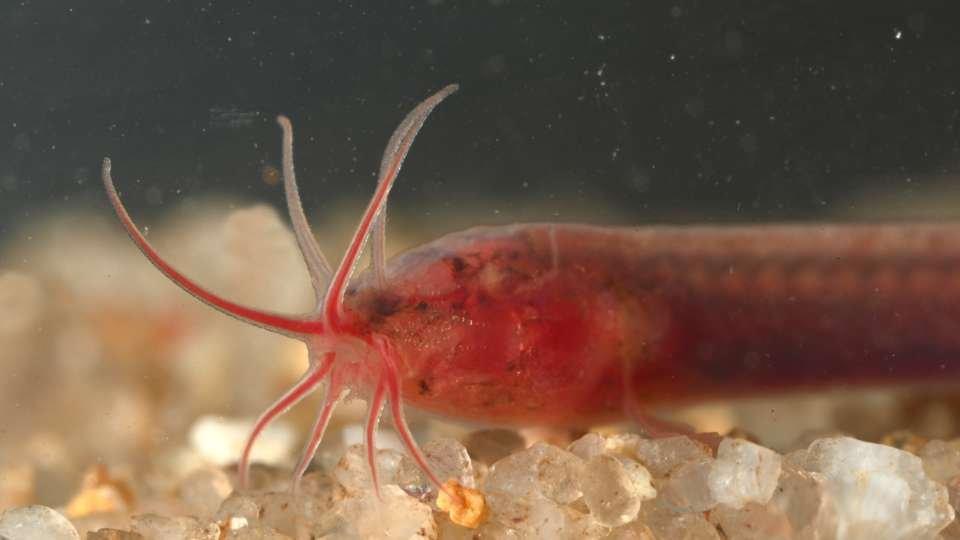
Tiny, Blind, and no Skull Roof: New Fish Species Discovered from a Well
Ever since the scientific description of the olm (Proteus anguinus) in the 18th century, subterranean animals have been a source of great fascination. Most of these creatures are known from caves, but some species have also adapted to other habitats hidden beneath the earth’s surface, such as aquifers – water-bearing layers of rock deep below ground. “Of the more than 37,000 fish species known worldwide, only around one percent have conquered the subterranean habitat and adapted to life underground. In turn, fewer than ten percent of these species live in aquifers. These so-called ‘phreatobitic’ fishes are discovered extremely rarely and usually only by chance,” explains Dr. Ralf Britz from the Senckenberg Natural History Collections in Dresden.
Unlike caves and their more easily accessible fauna, the “phreatic zone” – i.e., the subterranean groundwater layer – is difficult to access. Fishes that live there are usually discovered accidentally – for example, when wells, which are the only window into this habitat, are emptied and cleaned and their hidden inhabitants are thus literally brought to light. “Taking water from a well is exactly how we discovered the new fish species,” says Britz. “The loach, which is only 20 millimeters long, was found by biology student and doctoral candidate Wimarithy Marak in a self-dug well in a small town in the state of Assam, in Northeast India. When I was presented with this fish while on a research trip to the region in 2024, I immediately knew that this was a very special discovery.”
Together with his colleague Dr. Amanda Pinion from Dresden and the Indian doctoral student Velentina Kangjam, who worked in Dresden last year funded by a Senckenberg Global Fellowship, Britz examined the newly discovered fish and produced various micro-CT images of the skeleton. This allowed the international research team to describe the fish as a new genus and species, Gitchak nakana. “The tiny, blind loach is unusual enough that it warrants an entirely new genus,” says Britz. The initial specimen, as well as additional individuals discovered in the well in 2025, show typical characteristics of subterranean animals, such as greatly reduced or completely absent eyes, a lack of pigmentation with a pale, transparent appearance, enhanced non-optical senses, and elongated body appendages. “However, one anatomical detail is particularly spectacular: the animals do not possess a bony skull roof. The brain is only protected dorsally by a layer of skin – a unique feature among any of the loach species known to date,” adds the ichthyologist from Dresden.
With 21 known species found from either caves or groundwater systems, India ranks fourth in the world in terms of subterranean fish biodiversity. The main centers of this diversity are Northeast India – in particular the state of Meghalaya with six species – and the southwestern state of Kerala with 13 species. The discovery of Gitchak nakana represents a milestone: It is the first phreatobitic loach from Northeast India and also the first known aquifer-dwelling fish from this region. “The discovery of Gitchak nakana provides evidence that this region also harbors a highly specialized subterranean fauna in aquifers, which now awaits investigation,” adds Britz, looking ahead.
The newly discovered loach species Gitchak nakana in motion. Video: Senckenberg/Britz
Senckenberg – Leibniz Institution for Biodiversity and Earth System Research // Senckenberg Gesellschaft für Naturforschung
Senckenberganlage 25
60325 Frankfurt
Telefon: +49 (69) 7542-0
Telefax: +49 (69) 746238
http://www.senckenberg.de
Senckenberg Naturhistorische Sammlungen Dresden
Telefon: +49 (351) 795841-4343
E-Mail: ralf.britz@senckenberg.de
Leitung Pressestelle & Social Media
Telefon: 06975421434
E-Mail: judith.joerdens@senckenberg.de


Das könnte dich ebenfalls interessieren

Zinkdiethyldithiocarbamat Markt Spieler Erhalten Gelegenheit Mit Covid-19-Effektanalyse Im Jahr 2021
Innovationskraft ungebremst: Patentanmeldungen in Europa nehmen 2022 weiter zu