Vote Now: Who will be Mollusc of the Year 2026?
“By choosing the ‘Mollusc of the Year 2026,’ we want to highlight the enormous diversity of molluscs, the second-most species-rich animal group in the world. Molluscs occupy almost every habitat on our planet – from tiny snails barely visible to the naked eye to giant squid, which are among the largest invertebrates on Earth,” explains Prof. Dr. Julia Sigwart, Head of the Marine Zoology Department at the Senckenberg Research Institute and Natural History Museum Frankfurt, and she continues, “This impressive range of shapes, lifestyles, and adaptations is also evident in the five exceptional nominees for this year’s competition.”
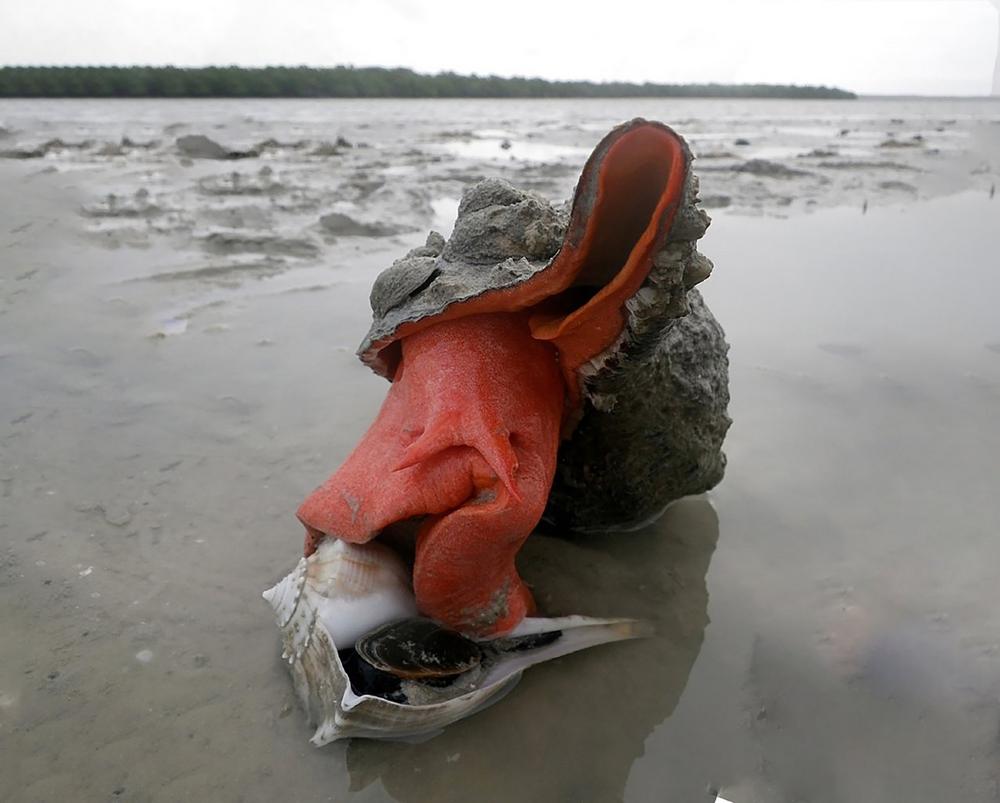
This year’s candidates for the title are the giant horse snail Triplofusus giganteus, the rock-eating shipworm Lithoredo abatanica, the vampire snail Cumia intertexta, the white slug Filicaulis seychellensis native to the Seychelles, and the “winged” moon cockle Ephippodonta lunata. An international jury of researchers from Senckenberg and the Unitas Malacologica selected them from among numerous nominations submitted by the global mollusc community. From April 13 to 26, mollusc fans can learn more about the nominated species on the website https://sgn.one/imoy2026 and cast their vote for their personal favorite.
“We were once again thrilled by the wide variety of submissions from all over the world – therefore, it was quite challenging to select the five finalists,” says Dr. Carola Greve, Head of the Laboratory Center for Biodiversity Genomics at the Senckenberg Research Institute and Natural History Museum Frankfurt. “Each of the nominated species impresses with its own story and its special, unique characteristics.”
Triplofusus giganteus, a snail living in the Atlantic, reaches a length of up to 60 centimeters and catches other molluscs with its massive foot. The shipworm Lithoredo abatanica drills its way through solid rock with sharply serrated teeth and is the first animal known to eat rock. The vampire snail Cumia intertexta, about two centimeters in size, feeds at night on the blood of resting fish by piercing their skin with its long proboscis. Filicaulis seychellensis is a tiny, pure white slug that lives exclusively on the island of Praslin in the Seychelles and was on the verge of extinction due to an invasive ant. The moon cockle Ephippodonta lunata from Australia has converted its shells into crescent-shaped “wings” and uses sponges or the tunnels of shrimps as its home.
“The selection of the ‘International Mollusc of the Year’ aims to emphasize the amazing diversity and uniqueness of this group of animals while at the same time drawing attention to their importance and need for protection. Many species remain undiscovered – some disappear before we have been able to understand their role in the ecosystem,” explains Sigwart. Greve adds, “Molluscs display an impressive genomic diversity, but comparatively few genomes have been fully decoded to date. We intend to determine the genome of the winning species – the giant horse conch would be studied with regard to its population development; the vampire snail with regard to the genetic basis of its blood diet; the rock-eating shipworm to investigate unusual survival strategies; the white slug to reconstruct its isolated evolution over millions of years; and the moon cockle to better understand symbioses and body transformations. We are curious to see which species will be awarded the title this year and which hitherto hidden genomic secrets it will reveal!”
The “International Mollusc of the Year 2026” will be announced on April 30.
Website with short portraits of the finalist species and voting: https://sgn.one/imoy2026
Senckenberg – Leibniz Institution for Biodiversity and Earth System Research // Senckenberg Gesellschaft für Naturforschung
Senckenberganlage 25
60325 Frankfurt
Telefon: +49 (69) 7542-0
Telefax: +49 (69) 746238
http://www.senckenberg.de
Senckenberg Research Institute and Natural History Museum Frankfurt
Telefon: +49 (69) 7542-1844
E-Mail: carola.greve@senckenberg.de
Senckenberg Research Institute and Natural History Museum Frankfurt
Telefon: +49 (69) 7542-1272
E-Mail: julia.sigwart@senckenberg.de?
Leitung Pressestelle & Social Media
Telefon: 06975421434
E-Mail: judith.joerdens@senckenberg.de