
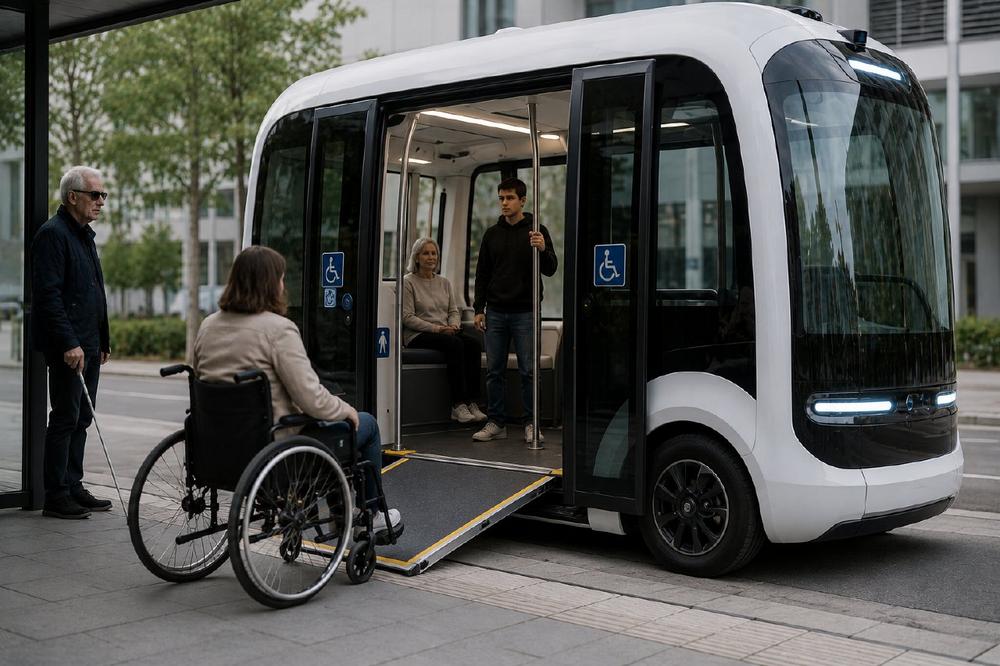
Arnold NextG Blogspot: Accessibility Is the Litmus Test for Autonomous Mobility
That is precisely why accessibility is not a secondary consideration. And it is certainly not an added benefit for later stages of development. It is a measure of whether new technology actually leads to public and inclusive mobility. After all, the value of a system is not evident where mobility is already easy. It is evident where people currently encounter obstacles—because existing options are unsafe, cumbersome, or unusable altogether. The federal government explicitly describes autonomous driving as an opportunity for greater participation, a better quality of life, and greater mobility for people who cannot or do not want to drive themselves.
Thus, the political direction is clear. Autonomous mobility is not justified solely on the basis of innovation, efficiency, or technological expertise. It is also explicitly linked to societal benefits: improved accessibility, greater independence, and new mobility options for people who are often not adequately served today.
Accessibility Doesn’t Start at the Car Door
Anyone discussing the future of public transportation must therefore think beyond the vehicle itself. Accessibility is not determined only at the point of boarding. It begins where mobility is planned: in the design of service areas, the booking logic, user guidance, passenger information, and operational processes.
The “Handbook on Autonomous Driving in Public Transportation” therefore explicitly addresses accessible vehicles and safe use as integral components of planning and operations—not as an afterthought for convenience.
It is striking that accessibility is still treated as a niche topic in many technology debates. Whether the topic is electric mobility, cybersecurity, or software-defined vehicles—it is often not considered until the architecture, functions, and user interface concepts have already been defined. However, it is precisely in the early development phases that it is determined whether a system will actually be usable by everyone later on. Accessibility should therefore be part of the system architecture from the very beginning. After all, only systems that function reliably even under demanding usage scenarios can fulfill their public mandate. Accessibility is therefore not an afterthought. It is a design criterion for robust, safe, and controllable systems.
Precision Determines Participation
This is precisely where accessibility becomes the ultimate test for autonomous mobility. After all, in situations where people rely on precise, safe, and reliable interaction, technical driving capability alone is not enough. The key factor is whether vehicle movement can be controlled in a reproducible manner under real-world conditions. This begins with the vehicle pulling up precisely at a stop, continues with stable vehicle positioning, and extends to transparent procedures for boarding and alighting. Any deviation can determine whether a mobility service is usable independently or not.
This makes accessibility the ultimate test of controllable vehicle movement. A demonstrator can show that a vehicle drives autonomously. Whether this translates into an inclusive mobility service is only determined in everyday life—where precision, repeatability, and controllable movement become prerequisites for independent mobility.
Control Enables Participation
This is precisely where the technological significance of this topic lies. Accessibility is not merely an application area of autonomous mobility. It demonstrates particularly clearly whether a system can actually master movement under real-world conditions.
For Arnold NextG, this is not an abstract concept, but rather part of its own development history. Drive-by-wire technology became relevant in situations where precise, reliable, and controllable movement at all times was not an option, but a prerequisite for self-determined mobility. This experience continues to shape the company’s technological approach to this day. After all, anyone who wants to safely master movement in sensitive usage scenarios needs more than just a convincing demonstration system. They need vehicle control that is designed to be reproducible, traceable, and fail-operational.
The same trend is evident internationally. Japan, too, explicitly links autonomous driving to social services and regional mobility. The Japanese ministry identifies three equally important prerequisites for this: safety, regional acceptance, and economic viability. Public benefit, therefore, does not begin with the technology itself, but with the question of whether mobility can be organized in a way that is permanently accessible and reliable.
With NX NextMotion, Arnold NextG addresses precisely this challenge. The platform treats vehicle control as an independent, fail-operational system layer, thereby laying the foundation for precise, controllable, and inclusive mobility systems.
Conclusion
Accessibility is not an added benefit of autonomous mobility. It is proof that controllable vehicle movement works under real-world conditions. Only when autonomous systems can handle the requirements of a wide variety of user groups with precision, reproducibility, and reliability does technological innovation give rise to a resilient public mobility offering. Inclusive mobility therefore begins not with vehicle equipment, but with system architecture.
Public mobility only lives up to its promise when it is reliably accessible to as many people as possible. This requires systems whose movement remains precise, reproducible, and controllable at all times. After all, control is the foundation of participation.
We Control What Moves
For more information, visit www.arnoldnextg.com/blog
Über Arnold NextG:
Arnold NextG realisiert die Safety-by-Wire®-Technologie von morgen: das mehrfach redundante Zentralsteuergerät NX NextMotion ermöglicht eine ausfallsichere und individuelle Implementierung, fahrzeugplattform-unabhängig und weltweit einzigartig. Mit dem System können autonome Fahrzeugkonzepte sicher und nach den neuesten Hard- und Software- sowie Sicherheitsstandards umgesetzt werden, ebenso wie Remote-, Teleoperation- oder Platooning- Lösungen Als unabhängiger Vorausentwickler, Inkubator und Systemlieferant übernimmt Arnold NextG die Planung und Umsetzung – von der Vision bis zur Straßenzulassung. Mit der Straßenzulassung von NX NextMotion setzen wir den globalen Drive-by-Wire-Standard. www.arnoldnextg.de
About Arnold NextG:
Arnold NextG realizes the safety-by-wire® technology of tomorrow: The multi-redundant central control unit NX NextMotion enables a fail-safe and individual implementation, independent of the vehicle platform and unique worldwide. The system can be used to safely implement autonomous vehicle concepts in accordance with the latest hardware, software and safety standards, as well as remote control, teleoperation or platooning solutions. As an independent pre-developer, incubator and system supplier, Arnold NextG takes care of planning and implementation – from vision to road approval. With the road approval of NX NextMotion, we are setting the global drive-by-wire standard. www.arnoldnextg.com
Arnold NextG GmbH
Breite 3
72539 Pfronstetten-Aichelau
Telefon: +49 171 5340377
http://www.arnoldnextg.de
Pressesprecherin
E-Mail: anke.leuschke@arnoldnextg.de


Das könnte dich ebenfalls interessieren
Die beste Lösung „klickt“
Der EQS SUV: Neu definierter SUV-Luxus