Safety nets in high-bay racking systems: underestimated and overrated at the same time
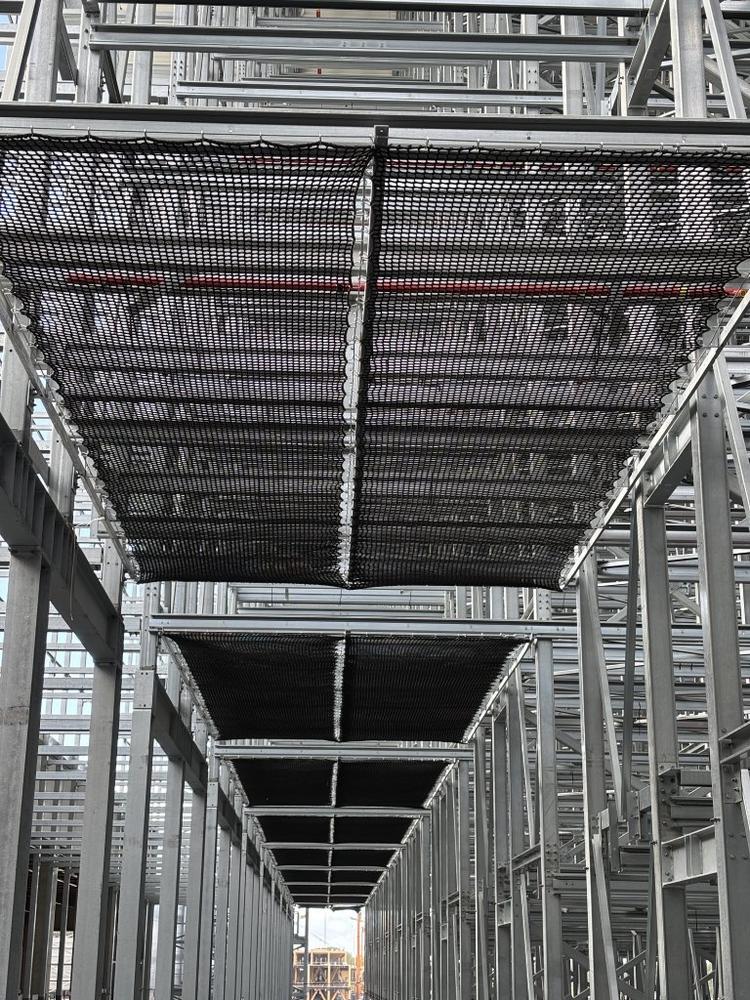
In highly automated high-bay warehouses, safety nets are often treated as a secondary or temporary measure. In practice, however, they are one of the most flexible safety solutions available for protecting people, goods, and infrastructure in intralogistics environments.
On many projects, safety nets are introduced late in the construction or commissioning phase, usually as a reaction to identified risks. When this happens, their full potential is rarely used.
From experience, safety nets work best when they are considered early in the project. If integrated during the design phase, they can often be incorporated into racking structures or supporting elements with only minor structural adaptations. This early planning can significantly reduce later installation effort and overall costs.
A key challenge today is the lack of a dedicated standard for permanent safety net systems in automated racking environments. With clear planning frameworks or guidelines in place, safety nets could already be defined during the design phase of a warehouse. This would allow interfaces between racking systems, automation technology, and safety measures to be coordinated in advance, rather than being resolved under time pressure on site.
At the same time, safety nets are sometimes overrated. In some projects, they are regarded as a universal solution that automatically provides safety once installed. This assumption can be misleading. A large safety net installed on a racking system without a clear fixing concept and structural logic does not necessarily provide effective protection.
Consider a pallet falling from a storage level at a height of 30 meters. If the net is not fixed or supported at intermediate levels, excessive deflection can occur. In such cases, the net may fail to absorb the load in a controlled manner. The net is present, but the actual system behavior under load has not been properly considered. This creates a false sense of security.
A safety net without a defined fixing strategy and technical understanding does not provide safety. It only creates the illusion of it.
For this reason, safety nets must be understood as part of a system, not as an isolated product.
Their performance depends on proper planning, defined load paths, fixing points and realistic load scenarios. In automated warehouses, racking systems are surrounded by sprinkler pipes, diagonal bracing, cable trays, and maintenance access routes. Installing safety nets as an afterthought often leads to compromises that reduce effectiveness and complicate installation and maintenance.
Although no official international standard currently exists for permanent safety net systems in such environments, practical experience, industry guidelines, and structured training concepts provide a solid basis for responsible system design. Training frameworks promoted within the industry, for example by organizations such as FASET, help establish a shared technical understanding of load behavior, fixing principles and installation requirements.
With a clear installation plan and defined responsibilities, installation teams specialized in steel or racking structures can safely integrate safety nets into their scope of work. These teams routinely handle complex assemblies and load-bearing components. The decisive factor is not who installs the net, but whether the system has been properly planned and understood.
To ensure that safety nets perform as intended, a coordinated approach is essential. This includes early project analysis, system-specific planning, precise manufacturing and a clear installation strategy. LOKET supports projects throughout this entire process, from safety concept development and installation planning to the production of project-specific net systems, installation on site or technical supervision of existing installation teams.
In highly automated warehouse environments, safety is not achieved through individual components, but through well-planned systems.
LOKET Handels- und Dienstleistungs GmbH
Schubertstrasse 6a
A8010 Graz
Telefon: +43 (664) 2227451
http://www.loket.at
Back Office Assistant
Telefon: +43 (676) 6730-493
E-Mail: iliana@loket.at