
From Brown to Green: Ground Personnel on Permanent Duty
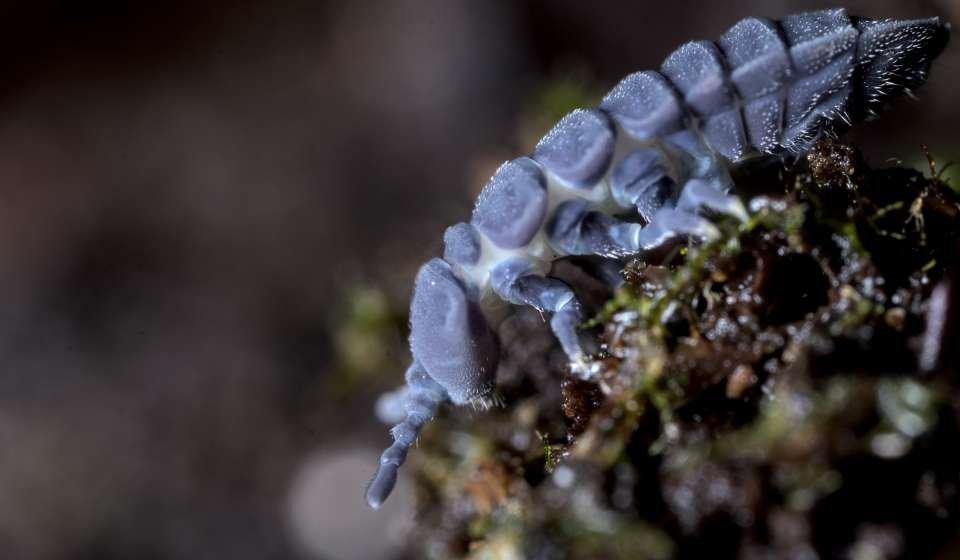
Beneath our feet, the forest floor is at work around the clock: Earthworms, springtails, nematodes, and many other animals break down plant debris and roots or hunt and consume other soil dwellers. These soil food webs channel a large part of the energy that flows through the terrestrial ecosystem. “The energy flow , i.e., how much energy passes through the food webs in total, is closely linked to their biodiversity and functionality. We already know that temperate and tropical forests are home to very different soil animals, but until now it was not clear what this means for the structure and functioning of their food webs,” explains the study’s first author, Prof. Dr. Anton Potapov from the Senckenberg Natural History Museum in Görlitz, and he continues, “In our new study, we calculate energy flows in order to identify general patterns: How are biomass and energy distributed among functional groups, such as small, medium, and large soil animals, from the southern taiga to tropical rainforests?”
For this purpose, the researchers collected data on the number and body size of nematodes, small arthropods, and larger soil animals at 32 locations in Germany, Russia, Indonesia, and Vietnam between 2013 and 2021. The samples were taken at times when soil animals are particularly active. The team used these data to calculate body masses and metabolic rates and combined them with isotope analyses and other characteristics to model food webs and estimate energy flows.
“Our analysis shows that the total biomass of soil animals is highest in the monsoon forest and lowest in the rainforest and southern taiga. Regardless of this, there is always a higher energy flow in tropical forests than in temperate forests,” explains Potapov. “What was surprising was that biomass and energy in the tropics were mainly concentrated in large animals. In addition, tropical soil food webs showed more predator-prey relationships and a higher level of herbivory, but less decomposition of foliage. Unexpectedly, the proportion of animals feeding on bacteria decreased, even though there is actually more bacterial biomass available in the tropics.”
In all forests, earthworms represent the majority of the biomass, followed by beetles, spiders, and mites. The proportion of larger animals increases steadily from the taiga towards the tropics. This trend reaches its peak in the monsoon forest. According to the study, the functions performed by different groups of animals depend heavily on the type of forest. In almost all forests, nematodes are responsible for the majority of bacterial and fungal consumption as well as a large proportion of herbivory. In temperate forests, they even dominate as predators. In tropical forests, on the other hand, large soil animals take over the role of the most important predators, and in monsoon forests also a large part of the herbivory. Depending on the forest, the breakdown of leaf litter is primarily accomplished by springtails, millipedes, or earthworms. “Earthworms are particularly prominent in all forest soils: As ‘ecosystem engineers,’ these annelids alter the soil itself and thereby also the food web. They channel energy through litter, soil, and dead wood and can override climatic differences between forests. We therefore also refer to them as ‘food web engineers,’” adds the soil researcher from Görlitz.
In temperate forests, soil food webs are mainly based on leaf litter and microorganisms. In tropical forests, on the other hand, living plants, dead wood, and organic soil matter also play a decisive role. In cooler forests, foliage accumulates and provides plenty of food for fungi and bacteria – and thus also for soil animals. In the tropics, however, foliage decomposes so quickly that soil animals have to rely more heavily on fresh plants or substances that are difficult to break down, such as wood or soil humus. From this, the researchers deduce two fundamentally different “modes of operation” for soils. In the “green” state, mainly freshly formed plant biomass is used, and there is intensive predator activity – typical of the tropics. In the “brown” state of temperate forests, the system relies more heavily on old, accumulated plant remains, and energy is transferred more slowly to higher levels. “These states can describe both entire ecosystems as well as developmental stages: Young systems are mostly ‘green,’ while mature systems tend to be ‘brown.’ How this changes across the seasons is still an open question,” says Potapov, and he adds, “Overall, our study shows clear geographical patterns that are primarily determined by temperature and metabolism, but can be strongly influenced locally by key species such as earthworms.”
Senckenberg – Leibniz Institution for Biodiversity and Earth System Research // Senckenberg Gesellschaft für Naturforschung
Senckenberganlage 25
60325 Frankfurt
Telefon: +49 (69) 7542-0
Telefax: +49 (69) 746238
http://www.senckenberg.de
Senckenberg Museum für Naturkunde Görlitz
Telefon: +49 (3581) 4760-5545
E-Mail: anton.potapov@senckenberg.de
Leitung Pressestelle & Social Media
Telefon: 06975421434
E-Mail: judith.joerdens@senckenberg.de


Das könnte dich ebenfalls interessieren

Remote Infrastructure Management (RIM) Markt Positive Nachfragetrends Bei Verschiedenen Hauptakteuren Mit Wachstumsstrategien Bis 2031

Laserschweißen soll Stahlbau revolutionieren