
Market Integration Package (MIP): What’s next for financial market participants
The core contents of the package are:
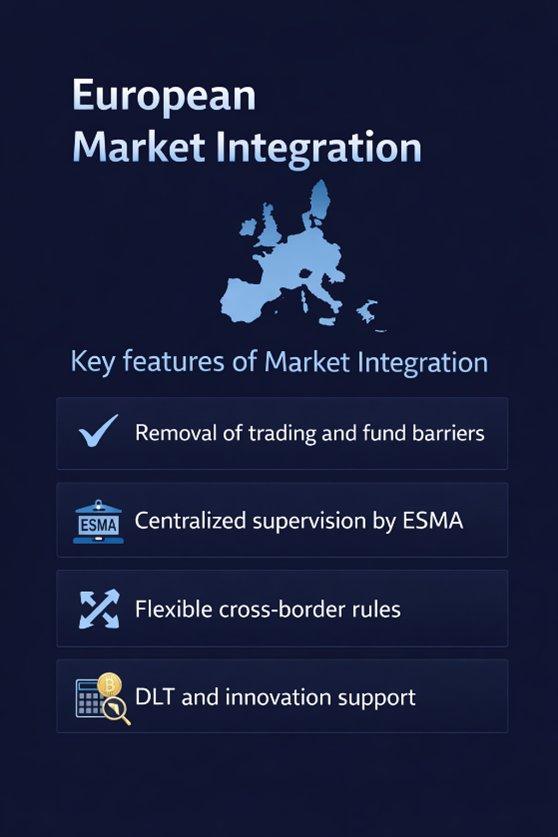
- Reduction of obstacles in trading, post-trading and fund distribution (including Pan-European Market Operator, expanded passporting options, reform of MiFIR/CSDR).
- Greater centralization and harmonization of supervision, in particular through new direct supervisory powers of ESMA over central market infrastructures and CASPs.
- Adjustments to fund and depositary law (UCITS/AIFMD, EU-wide Depositary Passport) to standardize cross-border business.
- Promoting innovation by expanding and making the DLT pilot regime more flexible and by designing finality and safeguards in a technology-neutral way.
S+P Compliance acts as the author and contextualizes the package from the perspective of securities institutions, banks and asset managers – focusing on new obligations, supervisory structures (ESMA direct supervision) and the practical implementation steps for governance, reporting and business models.
Overview of the content: Market Integration Package of the European Commission of 4 December 2025
A. Goal (meaning and purpose)
1. Removing barriers to market integration 2. Promoting innovation 3. Harmonizing and strengthening supervision 4. Simplifying capital market law
B. Implementation deadlines
Phased implementation is expected to begin from mid-2027 until approximately 2029.
C. Target group
Market infrastructures, particularly securities firms and credit institutions / banks. Note: Pure retail or lending banks without capital market, fund, or crypto activities are only affected to a limited extent, while capital market-oriented banks and securities firms are among the core target groups. Asset managers and the fund industry, crypto service providers, investors, and savers.
D. Essential duties
Cross-cutting obligations vary depending on the target group (for almost all target groups). See below for details. Regulatory change management (analysis, gap assessment, implementation plan). Revision of internal guidelines and compliance processes. Reporting/data capability (regulatory-driven, EU-harmonized). Training of key roles (compliance, legal, risk, operations).
E. Action plan for implementation
The target groups essentially need to adapt their governance, processes , IT /reporting, and supervisory relationships to the new, more centralized EU regime . See below for further details.
Target audience
Measures / key implementation steps
1. Trading venues, CCPs, CSDs, future PEMOs
Regulatory gap analysis against new MiFIR/MiFID requirements (market structure, transparency, access, best execution) + implementation plan. ESMA readiness: establish central reporting channels to ESMA (order/transaction data, market surveillance, sanctions notifications), define responsibilities + ESMA engagement plan. Contract/infrastructure adjustments: review clearing and CSD access agreements, interoperability agreements, cross-border links and align them with new access/hub rules. For potential PEMOs: group/structural analysis, passport strategy, and aligning registration documents/organizational manual with the new status.
2. UCITS and AIFM Management Companies
Adapt authorization and distribution processes: simplified notification procedure ("single notification" for residential care supervision, no additional requirements from the host NCA). Reporting consolidation: harmonize UCITS/AIFM reports, identify duplicate reports, align systems with uniform templates/ESMA data requirements. Review delegation and group structures: review delegation chains, sub-advisory models, and intra-group outsourcing against more precise AIFMD/UCITS delegation requirements; strengthen governance/monitoring.
3. Depositaries
Preparing for EU depositary passports: Define target jurisdictions, license and passport strategy. Develop the operating model for cross-border funds: Design account, cash and collateral processes, oversight functions and reporting to efficiently serve multiple supervisory authorities and ESMA.
4. CASPs and DLT market infrastructure operators
Integrate MiCAR and ESMA supervision: align governance, market abuse monitoring, product approval, and customer processes with ESMA standards; establish central data/reporting channels. Review DLT strategy and infrastructure: assess participation in the expanded DLT pilot regime; if participating, adapt account models, custody structures, IT security, and legal documentation (token settlement, finality, collateral).
5. Cross-cutting measures (all target groups)
Establish program/project structure: multi-year transformation program, integration with MiCAR, DORA, ESAP, etc. Centralize reporting and data governance: harmonized templates, uniform data repositories, develop interfaces to ESMA platforms. Supervisory strategy and communication plan: responsibilities for ESMA interaction, preparation for joint audits/requests with NCAs, training of management and specialist departments.
A. Goal
The European Commission’s Market Integration Package of 4 December 2025 is a significant component of the planned Savings and Investments Union (SIU) . Its aim is to further integrate EU capital markets, reduce regulatory hurdles, and strengthen the competitiveness of the European financial system.
Essentially four key areas of action :
1. Removing barriers to market integration
The Commission aims to facilitate cross-border capital flows, reduce cost differences, and leverage economies of scale. The following measures are planned:
- Extended EU passportfor markets and central securities depositories (CSDs);
- Introduction of a new status “Pan-European Market Operator”;
Simplified cross-border fund distribution to reduce regulatory barriers.
Goal: A more uniform and efficient market structure within the EU.
2. Promoting innovation
The legal framework is to be opened up to distributed ledger technologies (DLT) .
The following are planned:
- Amendments to the DLT pilot regulationto lift certain restrictions,
- Greater flexibility and legal certaintywhen using blockchain-based solutions in the financial sector.
This provides targeted support for innovations in trading and settlement processes.
3. Standardization and strengthening of supervision
To reduce fragmentation and increase the efficiency of cross-border supervision, the Commission proposes:
- Transfer of direct supervisory powersover central market infrastructures (trading platforms, CCPs, CSDs) and all crypto service providers (CASPs) to ESMA ,
- Strengthening the coordinating role of ESMAin the area of fund supervision.
This means a clear centralization of important supervisory powers at EU level.
4. Simplification of capital market law
The following measures are proposed to reduce administrative burdens:
- Conversion of directives into directly applicable regulations,
Streamlining Level 2 authorizations ,
- Reduction of national options and discretionary leewayto avoid gold-plating .
This is intended to standardize the application of the law and relieve the burden on companies.
B. Implementation deadlines
There are currently no fixed, uniform implementation deadlines because the Market Integration Package of 4 December 2025 must first go through the full legislative procedure (EP/Council, trilogue, publication in the Official Journal).
What can be deduced from the existing documents and expert commentaries:
- The proposals will be considered in the ordinary legislative process; adoption is expected around the end of 2026.
- The applicationof the key regulations is typically planned for 12–24 months after entry into force ; i.e., a phased start is expected from mid-2027 to around 2029 .
Since these are (still) drafts , this data should be understood as planning or expectation figures , not as definitively binding implementation deadlines. For a specific institution, I would therefore expect an implementation horizon of approximately 2–3 years after entry into force and await the final regulations/guidelines in the Official Journal.
C. Target group
The target group of the Market Integration Package is the entire EU financial sector, with a focus on players in the capital market and fund industry, in particular:
- Market infrastructures: Trading venues (regulated markets, MTF/OTF), central counterparties (CCPs) and central securities depositories (CSDs), which are to be more integrated and partly directly supervised by ESMA.
Excursion
Both securities institutions and credit institutions/banks are affected – partly directly, partly indirectly through their roles in the market and fund business.
Securities institutions
Many changes are being implemented via MiFID II / MiFIR : organizational and operational requirements for trading venues and investment firms/brokers are being transferred into a single, directly applicable regime.
Securities institutions acting as trading venue operators, brokers/dealers, clearing or post-trading participants must adapt their market structure, transparency, access and reporting processes to the new “Single Rulebook”.
- Only credit institutions or investment firms with a specific license can use the new EU-wide Depositary Passport as depositaries for UCITS/AIFs – additional requirements apply.
Banks are addressed, insofar as they are considered
o Operators or participants of trading venues, CCP or CSD structures ,
o Custodian banks/custodians for funds,
or significant capital market and issuing houses .
For such banks, this means: greater harmonization of capital market and fund rules , possible direct ESMA supervision of central market infrastructures and adaptation of governance, reporting and cross-border business models.
End of digression
- Asset managers and the fund industry: UCITS and AIFM management companies, asset managers and their fund products (UCITS, AIFs), particularly with regard to cross-border distribution and harmonization of requirements.
- Crypto service providers (CASPs)and other investment firms that fall under MiFID/MiFIR, EMIR, CSDR, etc., and whose supervision is more centralized, as well as requirements for trading, post-trading, and tokenization being adapted.
- Investors and saversin the EU are an indirect target group, as the SIU aims to provide private and institutional investors with better integrated, cost-efficient and cross-border accessible capital markets.
From a compliance perspective, this means that practically all institutions that provide capital market, fund or crypto services across borders in the EU internal market or operate market infrastructure are affected.
D. Essential duties
The main obligations of the target group (typically: banks/securities firms, trading venues, CCPs/CSDs, KVGs/fund providers, crypto service providers) arise from the package primarily indirectly – through more EU-wide standardization, stronger ESMA supervision and new/expanded passporting rules .
1) Market infrastructures: Key obligations (trading platforms, CCPs, CSDs)
- Preparation for direct ESMA supervision(instead of/not just national authorities)
- Compliance with harmonized EU requirements(fewer national deviations)
- Evidence of robust governance and control systems(supervisory capability, reporting capability)
- Implementation of new passport/status regulations(if use is planned, e.g., Pan-European Market Operator)
2) Crypto Service Providers‘ Essential Obligations (CASPs)
- Subject to ESMA supervision(centralized, cross-border)
- Establish/expand EU-wide compliance and reporting processes
- Stricter requirements for organization, risk management, and controls(supervisory audit capability)
3) Fund industry / Asset management Key obligations (investment management companies, fund distributors)
- Adaptation to simplified rules for cross-border distribution
- Implement EU-harmonized requirements(fewer national special cases)
- Give greater consideration to supervisory coordination by ESMA(e.g., regarding interpretation issues/standards)
4) Trading / Post-Trade / Securities Settlement Key Obligations (Banks, Brokers, Custodians)
- Process adjustmentsfor using new EU passport options
- Standardizationof interfaces/processes in cross-border business
Cost and efficiency requirements increase due to comparability/scalability.
5) Innovation / DLT usage (DLT pilot)
For institutions that want to use DLT:
- Review of the new DLT flexibilities
- Legally compliant implementationincluding governance, IT/cyber risk, and control framework
- Documentation and verification obligationstowards supervisors/auditors
6) Cross-cutting obligations (for almost all target groups)
- Regulatory change management(analysis, gap assessment, implementation plan)
- Revision of internal guidelines & compliance processes
- Reporting/data capability(supervisory-driven, EU-harmonized)
- Training of key roles(Compliance, Legal, Risk, Operations)
Measuresfor the implementation of the Market Integration Package
The target groups essentially need to adapt their governance, processes, IT/reporting and supervisory relationships to the new, more centralized EU regime .
1. Trading venues, CCPs, CSDs, future PEMOs
- Regulatory gap analysisagainst the new MiFIR/MiFID requirements (market structure, transparency, access, best execution) and derivation of an implementation plan.
- Establish ESMA readiness: set up central reporting channels to ESMA (order/transaction data, market surveillance, sanctions notifications), define internal responsibilities and an ESMA engagement plan.
- Contract and infrastructure adjustments: Review clearing and CSD access agreements, interoperability agreements and cross-border links and align them with the new access and hub rules.
- For potential PEMOs: Analyze the group and structure, develop a passport strategy, and adapt the admission documents/organizational handbook to the new status.
2. UCITS and AIFM management companies
- Adaptation of the approval and distribution processesto the simplified, uniform notification procedure (one “Single Notification” to the home supervisory authority, no additional requirements from the Host-NCA).
- Reporting consolidation: Harmonizing UCITS and AIFM reporting, identifying duplicate reports and aligning systems with unified templates/ESMA data requirements.
- Review delegation and group structures: Examine delegation chains, sub-advisory models and intra-group outsourcing against the specified AIFMD/UCITS delegation requirements and tighten governance/monitoring.
3. Depositaries
- Preparing for the EU-wide Depositary Passport: assessing in which jurisdictions cross-border depositary banking services should be offered and defining a corresponding licensing and passport strategy.
- Expand the operating model for cross-border funds: design account, cash and collateral processes, oversight functions and reporting in such a way that multiple supervisory authorities and ESMA can be served efficiently.
4. CASPs and DLT market infrastructure operators
- Integrate MiCAR and ESMA supervision: Bring governance, market abuse monitoring, product approval and customer processes to ESMA standards, and establish central data and reporting channels.
- Review DLT strategy and infrastructure: Decide whether participation in the extended DLT pilot regime makes sense; if participating, adapt account models, custody structures, IT security and legal documentation (token settlement, finality, collateral).
5. Cross-cutting measures (all target groups)
- Set up project and program structurefor MIP/SIU implementation (multi-year transformation program, linking with MiCAR, DORA, ESAP, etc.).
- Centralize reporting and data governance: develop harmonized templates, uniform data repositories and interfaces to ESMA platforms.
- Supervisory strategy and communication plan: clear responsibilities for ESMA interaction, preparation for joint audits/requests with NCAs, training of management and specialist departments.
Here are the most important primary sources directly from the EU and ESMA; as of today, there is no explicit BaFin technical announcement on the package, so you can only refer generally to BaFin as the NCA.
European Commission (EU)
- Overview page “Market integration package” (including legislative proposals, fact sheets, FAQs): https://finance.ec.europa.eu/publications/market-integration-package_en[ ec.europa ]
- Communication on the package (political framework, objectives, measures): https://ec.europa.eu/finance/docs/law/251204-communication-mip_en.pdf[ europa ]
- Legislative proposals (selection):
– “Proposal for a regulation regarding the further development of capital market integration and supervision within the Union – Master Regulation” (link via the EC website mentioned above, section “Legislative proposals”). europa+1
– „Proposal for a directive regarding the further development of capital market integration and supervision within the Union – Master Directive“.europa+1
– Proposal for a Settlement Finality Regulation (SFR), also available via the Market Integration Package page. [ ec.europa ]
- Q&A / FAQ about the package (also available in German):
– EN: https://ec.europa.eu/commission/presscorner/detail/en/qanda_25_2894[ europa ]
– DE: https://ec.europa.eu/commission/presscorner/detail/de/qanda_25_2894[ europa ]
ESMA
- ESMA‑Pressemitteilung „ESMA welcomes Commission’s ambitious proposal on market integration“ vom 4.12.2025: https://www.esma.europa.eu/press-news/esma-news/esma-welcomes-commissions-ambitious-proposal-market-integration[europa]
- ESMA website – Homepage with reference to the package and position paper: https://www.esma.europa.eu[ europa ]
S&P Unternehmerforum GmbH
Feringastr. 12 A
85774 Unterföhring bei München
Telefon: +49 (89) 45242970100
Telefax: +49 (89) 45242970299
http://www.sp-unternehmerforum.de
E-Mail: cb@sp-unternehmerforum.de