Smart upgrade instead of scrapping: How LGR Reine, together with Krifft & Zipsner, has made its intralogistics fit for the future.
Making an existing production plant future-proof
LGR Packaging also faced this problem. The company, headquartered in OYONNAX, France, is one of the largest manufacturers of printed folding cartons for pharmaceuticals and many other applications in litho lamination.
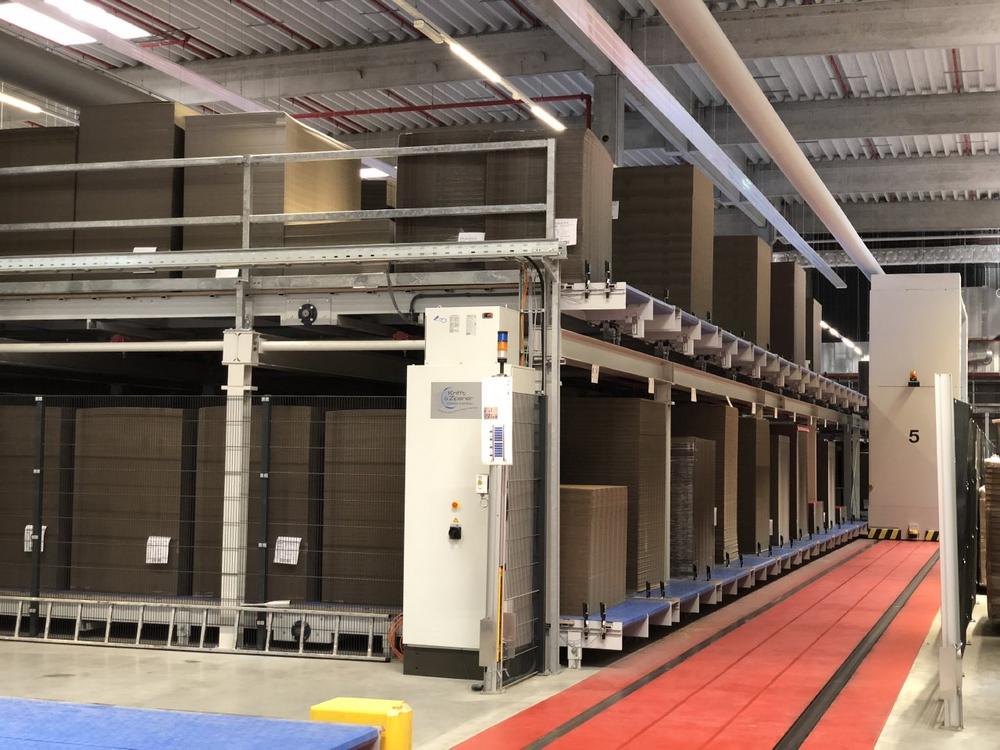
At the Reine site, LGR Packaging uses several conveyor lines from Krifft & Zipsner as intermediate storage between the printing plant with a capacity of 35 piles per hour on 76 conveyor lines over two levels and an intermediate storage facility in the die-cutting plant with 42 conveyor lines on one level. In addition, there are five transfer trolleys as a transport medium between the lines, the two storage areas and the inflow and outflow of the machines. Furthermore, a rotary unit and two pile turners are installed.
The entire conveyor technology supplied by Krifft & Zipsner, including the Siemens control system, has been repeatedly expanded and modified during its 25 years of use. Some of its modules were no longer compatible with Windows 11 because the applications could no longer be extended and the entire system, including the development environment, was tied to old hardware. An update of the hardware and software to a new operating system version was therefore not possible.
Since rewiring, new control cabinets and reprogramming would have far exceeded the planned budget, no new control systems should be installed.
Therefore, the software had to be completely rebuilt using current tools for further use. The system, including operational data acquisition, should also be connected to the customer’s own enterprise resource planning (ERP) system.
KriZiTransdesk makes existing machinery fit for the future.
Specifically, LGR Reine involved two HMI (Human-Machine-Interface) applications under Windows, connected to 17 Siemens S7-300 for warehouse management, to a Marquip cross cutter and three K&B printing machines as well as four die-cutting machines and three ASI-Trade laminating machines, whose use were to be continued and made fit for the future.
Krifft & Zipsner achieved this primary goal with the implementation of their own software KriZiTransDesk in the Professional and Web versions. KriZiTransDesk takes over the control of logistics between the machines, thus also circumventing the compatibility problem. The connection to the customer’s own MES was established via an MS-SQL database.
Software update used for process automation
LGR had installed new production machines in recent years, thereby increasing its capacity. Since the old HMI software had only been partially expanded, the original logistics concept no longer met the increased requirements.
Therefore, manual intervention was always necessary with the old applications. During his shift, the respective area manager was often busy having individual piles or orders transported to the machines in semi-automatic mode, or carrying out relocations.
Therefore, with the implementation of the new HMI, measures for automation were implemented: RFID connection of the transfer trolleys to ensure order data per pile and, if possible, order-specific storage, so that no unnecessary transfers are necessary.
The order sequence for the delivery of the machines will now also be determined by the planning department via a database connection. To provide greater flexibility in production, the option to freely select a pool of up to five orders was also created. Manual ordering of individual orders is still possible.
The newly established warehouse and stack tracking system also makes it possible to place orders from the various operating stations of printing and laminating machines using "Order Tool", and these are then transported fully automatically and as needed between the areas.
The printing machines are no longer supplied via order numbers alone, but now via similar goods, specifically: length, width and cardboard properties.
In addition, the retrieval of orders from the printing company’s warehouse to the three laminating machines was automated to such an extent that the required quantities, or piles, are transported to a small intermediate storage area with up to three piles per laminating machine.
If a rotation of the piles is necessary, a turntable is automatically approached beforehand, the pile is rotated and then moved to the appropriate destination of the intermediate storage. The respective feeder will also be automatically supplied.
Conclusion: A problem was turned into an opportunity – and then used to the best possible extent.
The new software solution not only allows the existing logistics solution to continue to be used, but also enables an automatic flow of customer orders: The entire manufacturing process, from the cross cutter via transfer trolley to the printing intermediate storage area and from there via another transfer trolley to the printing machines and then to the intermediate storage area for the laminating machines, now works without manual intervention.
After the machine operator retrieves the required orders for the laminating machines, the piles are automatically transported from the intermediate storage area via a third transfer trolley, through a rotary unit, back to the intermediate storage area, and then to the feeder of the laminating machines.
With the new solution based on KriZiTransDesk Professional and Web, a fully automated and future-proof storage and transport system has been created, which fully meets today’s required "just-in-time" delivery of machines.
Since the conversion at the Reine plant more than met expectations, another plant has already been converted, and two more are to follow.
Learn more about Krifft & Zipsner’s solutions at krifft-zipsner.de
Krifft & Zipsner GmbH
Industriestraße 4
57520 Steinebach
Telefon: +49 (2747) 9240-0
Telefax: +49 (2747) 9240-45
http://www.krifft-zipsner.de
Leitung Produktmanagement
Telefon: +49 2747 924024
E-Mail: florian.nitschke@krifft-zipsner.de