
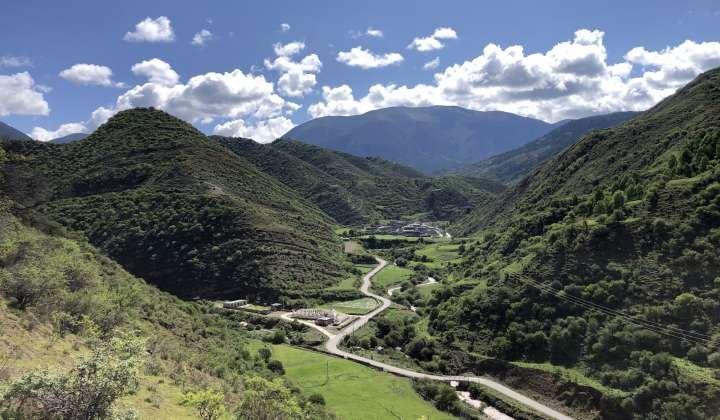
The Roof of the World: A Biodiversity Hotspot for 39 Million Years
Mountain ranges are among the most species-rich habitats on Earth. A wide variety of conditions converge here in a small area—from deep valleys to high peaks, from warm to cold, and from dry to humid habitats. This gives rise to diverse ecological niches that offer many species room to adapt and evolve. “A particularly striking example are the Hengduan Mountains in eastern Tibet. The rugged mountain landscape, with its high peaks and deeply carved valleys, ranges from subtropical to alpine climate zones. Today, the region is one of the world’s most important biodiversity hotspots, home to numerous endemic species,” explains Prof. Dr. Andreas Mulch, Director at the Senckenberg Research Institute and Natural History Museum in Frankfurt, and he continues, “The plant fossils from the Hengduan Mountains have been extensively studied and provide important insights into past biodiversity, elevation, and climate. The region’s fossil mammal fauna is impressive in many respects and offers previously unknown insights into the early evolution of high-altitude species.”
In a new study, the Frankfurt-based geoscientist, along with a Chinese-German research team, investigated how and when the extraordinary biodiversity on the Tibetan Plateau emerged. By dating mineral deposits in fossilized mammal bones and paleosols, combined with elevation reconstructions based on stable isotopes from the tooth enamel of herbivores and from soil carbonates, the researchers were able to show that as early as about 39 million years ago, extensive high-mountain landscapes with species-rich mammal communities already existed in eastern Tibet. “Dating back 39.2 to 38.1 million years, these fossils represent the oldest directly dated Cenozoic mammalian fauna on the Tibetan Plateau. The herbivores we sampled lived at elevations of about 3,400 meters—i.e., in a habitat whose elevation already closely approaches current-day conditions,” adds Dr. Songlin He, a scientist at the Senckenberg Biodiversity and Climate Research Center in Frankfurt and the Institute for Tibetan Plateau Research, CAS, in Beijing.
The formation of the mountain range itself apparently played an important role in the development of Tibetan biodiversity. As eastern Tibet gradually rose during the Eocene, about 56 to 34 million years ago, the climate also changed. This led to pronounced seasonal precipitation. Mulch explains, “This climate cannot be equated with today’s Asian monsoon, but the strong seasonality of precipitation was an important element of the environmental conditions in the highlands.” The study’s key evidence is the presence of so-called false growth rings—fluctuations in density during wood formation—in the 41.5-million-year-old fossilized wood. These occur when plant growth is subjected to drought stress in the summer. “This is typical of a ‘Mediterranean’ climate, such as that found in the Mediterranean region today, and created favorable environmental conditions for the development of a species-rich high-mountain fauna and flora,” adds He.
The new findings provide an important chronological reference point for the early development of high-mountain biodiversity in Asia. At the same time, they demonstrate how closely mountain formation, climate change, the emergence of new ecosystems, and the long-term evolution of biodiversity are linked. “The history of biodiversity on the Tibetan Plateau extends back much further than previously known. Eastern Tibet played a key role very early on in the development of today’s high-mountain biodiversity in Asia. Evidence of a Mediterranean climate pattern in Tibet 41.5 million years ago shows just how crucial paleoclimate reconstructions can be to our understanding of the climate system,” adds Mulch in conclusion.
Senckenberg – Leibniz Institution for Biodiversity and Earth System Research // Senckenberg Gesellschaft für Naturforschung
Senckenberganlage 25
60325 Frankfurt
Telefon: +49 (69) 7542-0
Telefax: +49 (69) 746238
http://www.senckenberg.de
Senckenberg Forschungsinstitut und Naturmuseum Frankfurt
Telefon: +49 (69) 7542-1881
E-Mail: andreas.mulch@senckenberg.de
Leitung Pressestelle & Social Media
Telefon: 06975421434
E-Mail: judith.joerdens@senckenberg.de