-
2,647 km per kilogram of hydrogen are no coincidence
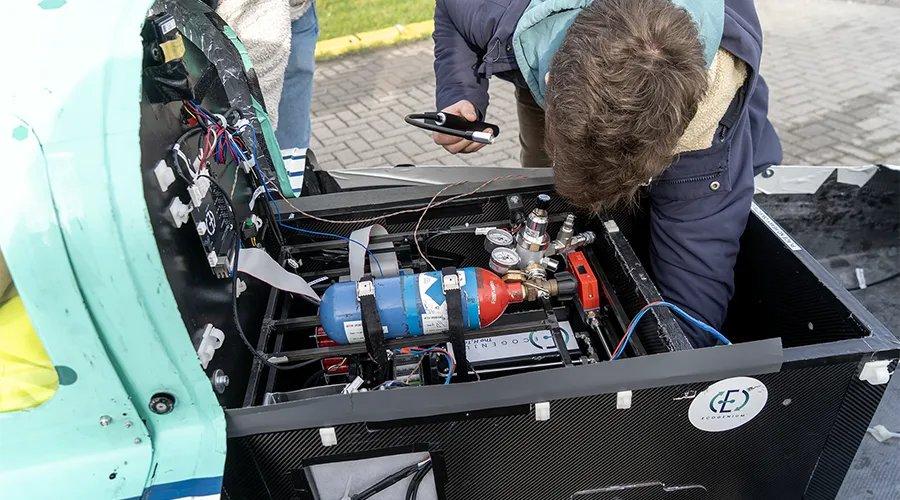
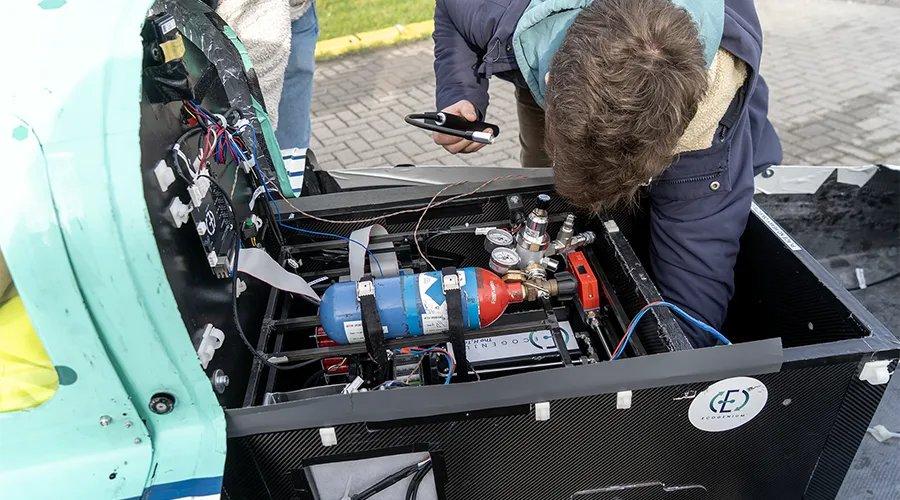
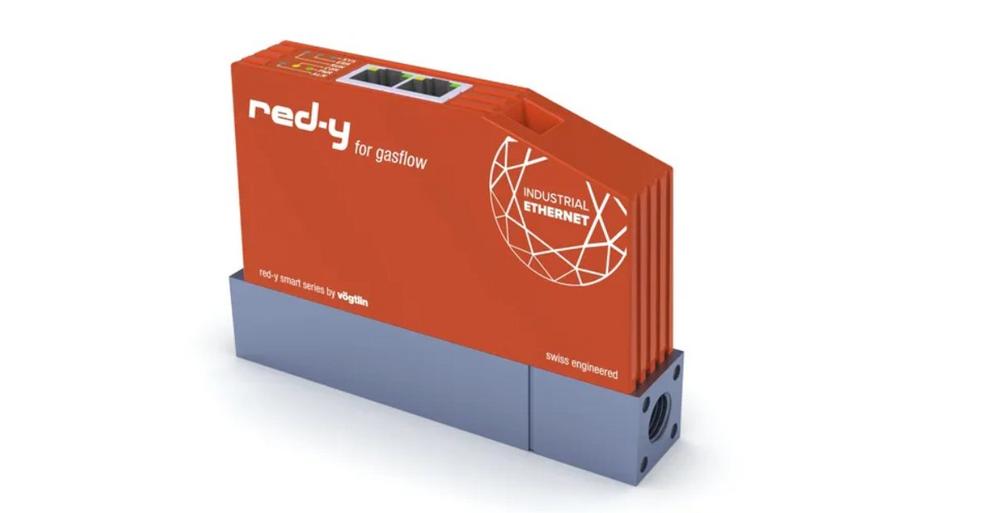
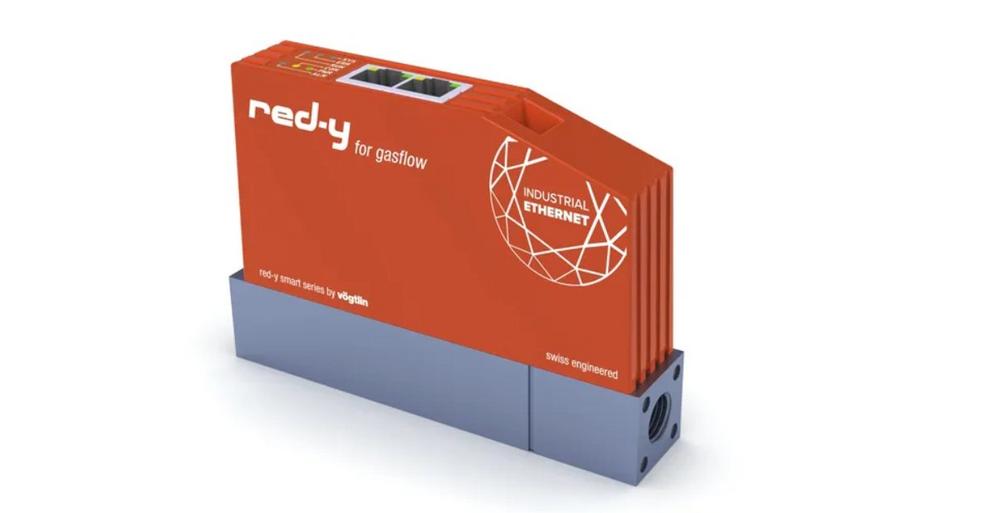
Shell Eco-marathon | Hydrogen Prototype “Hydraix II” At the Shell Eco-marathon 2025, the Ecogenium team achieved a specific range of 2,647 km/kg H₂ with its hydrogen prototype vehicle Hydraix II, securing second place worldwide. Achieving this level of efficiency required the exact, reproducible, and dynamically stable measurement of the hydrogen mass flow throughout the entire driving cycle. Real-time hydrogen flow measurement The red-y smart series mass flow meter from Vögtlin Instruments was integrated into the vehicle’s hydrogen supply system to continuously measure the mass flow directly in the supply line. Measurement data were transmitted in real time to the control system and used both for consumption monitoring and for…
-
2.647 km pro kg Wasserstoff sind kein Zufall
Shell Eco-Marathon | hydrogen Prototype „Hydraix II“ Beim Shell Eco-Marathon 2025 erreichte das Ecogenium Team mit ihrem hydrogen Prototype Fahrzeug Hydraix II eine spezifische Reichweite von 2.647 km/kg H₂ und belegte damit Platz 2 weltweit. Um dieses Effizienzniveau zu realisieren, war eine exakte, reproduzierbare und dynamisch stabile Erfassung des Wasserstoff-Massestroms über den gesamten Fahrzyklus hinweg erforderlich. Wasserstofffluss in Echtzeit Der red-y smart series Massedurchflussmesser von Vögtlin Instruments wurde im Wasserstoffversorgungssystem des Fahrzeugs integriert, um den Massestrom direkt im Versorgungsstrang kontinuierlich zu erfassen. Die Messdaten wurden in Echtzeit an das Steuerungssystem übergeben und dienten sowohl der Verbrauchsüberwachung als auch der nachgelagerten Analyse zur Optimierung von Regelstrategie und Fahrprofil. Aufgrund des…
-
Vögtlin did it again! Advanced gas flow measurement and control
After obtaining an innovation award for the compact versatile mass flow meter, Vögtlin got the 2025 innovation award for the d·flux mass flow controller/meter. These multiparameter (mass flow, volumetric flow, temperature, pressure and density) are based on viscosity depended differential pressure measurement over an advanced laminar flow element. The viscosity and density are calculated based the refprop (NIST) database by accurately measuring the pressure and the temperature. Due to this you get highly accurate readings of the flow independent of pressure and temperature changes. With this calculation you can program almost any gas in the flow meter based on the basic air calibration. This makes the unit economical for any…
-
Why Gases Matter in Bioprocessing – Smart Mass Flow Controllers for Reliable Bioreactors
Gases play a critical role in bioreactors, especially in aerobic bioprocesses where microorganisms or cells require oxygen to grow and function. But why are these gases so important? What do they do and why do I have to select high quality mass flow controllers? Gases in aerobic bioprocesses primarily perform the following tasks Oxygen supply: microorganisms and mammalian cells need Oxygen to live, grow and multiply. It is their respiration. Too little and they do not grow, too much and you have the risk of oxidative stress, metabolic shifts, increased shear stress because of the required higher agitation or sparging rates. For most processes the optimum DO (Dissolved Oxygen) is 20…
-
Warum Gase in Bioprozessen entscheidend sind – präzise Massedurchflussregler für zuverlässige Bioreaktoren
Gase spielen in Bioreaktoren eine entscheidende Rolle – insbesondere in aeroben Bioprozessen, bei denen Mikroorganismen oder Zellen Sauerstoff benötigen, um zu wachsen und zu funktionieren. Doch warum sind diese Gase so wichtig? Welche Aufgaben erfüllen sie – und warum sollte man hochwertige Massedurchflussregler einsetzen? Aufgaben der Gase in aeroben Bioprozessen Sauerstoffversorgung: Mikroorganismen und Säugetierzellen benötigen Sauerstoff, um zu leben, zu wachsen und sich zu vermehren – er ist ihr „Atem“. Zu viel Sauerstoff kann zu oxidativem Stress, Veränderungen im Stoffwechsel und zu einer stärkeren mechanischen Belastung der Zellen führen – verursacht durch intensiveres Rühren oder eine höhere Gaszufuhr. Für die meisten Prozesse liegt der optimale DO-Wert (Dissolved Oxygen) zwischen 20 und 40 %. Abfuhr…
-
Erzeugung von Wasserstoff (H₂) aus Elektrolyseuren
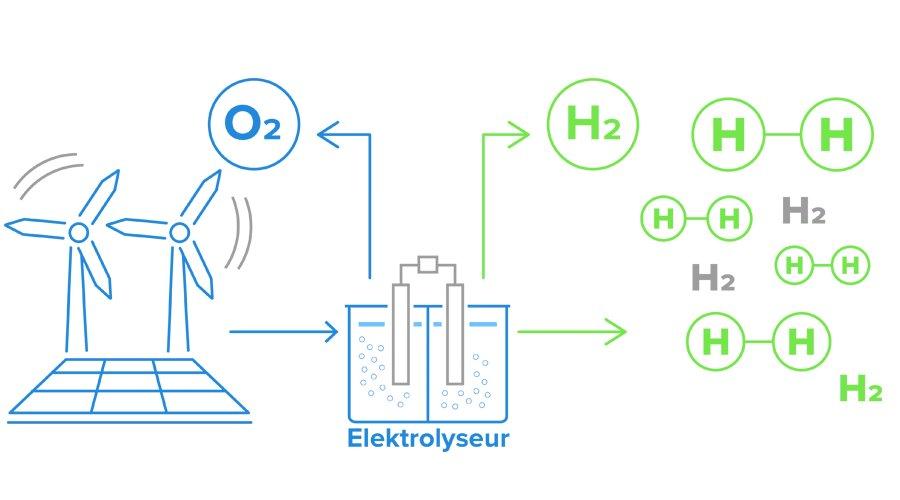
Elektrolyseure nutzen elektrischen Strom, um Wasser (H₂O) in Wasserstoff (H₂) und Sauerstoff (O₂) zu spalten. Diese Systeme sind so ausgelegt, dass sie kontinuierlich Wasserstoffgas erzeugen, wobei der Wasserstoff im Fokus steht und der Sauerstoff häufig ungenutzt bleibt. Die Menge des erzeugten Wasserstoffs hängt direkt von der Leistungsaufnahme des Elektrolyseurs ab. Der Wirkungsgrad eines Elektrolyseurs beschreibt, wie viel Wasserstoff er im Verhältnis zur verbrauchten elektrischen Energie produzieren kann. Daher ist eine präzise Messung der Wasserstoffproduktion von entscheidender Bedeutung. Der erzeugte Wasserstoff ist jedoch zunächst mit Wasserdampf gesättigt und die meisten Durchflussmesser sind bei der Messung von feuchtem oder nassem Wasserstoff aufgrund der unterschiedlichen Eigenschaften von Wasserstoff und Wasserdampf weniger genau. Um…
-
Generating Hydrogen (H₂) from Electrolysers
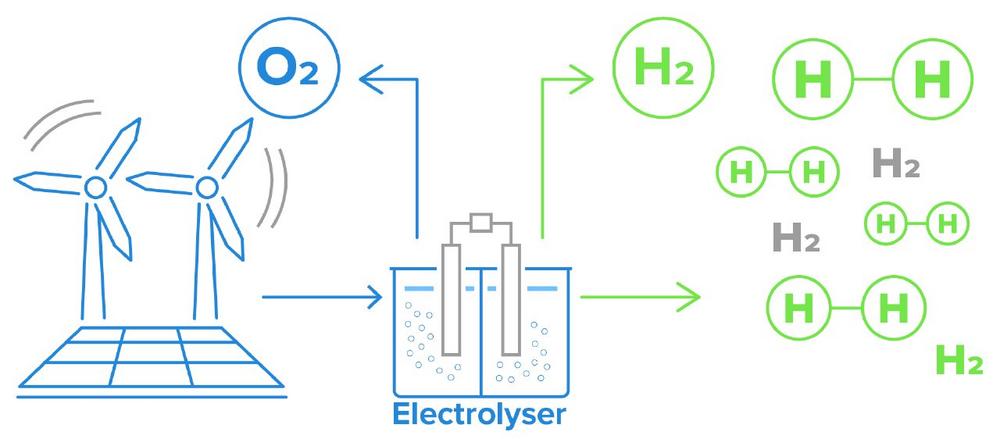
Electrolysers use electrical current to split water (H₂O) into hydrogen (H₂) and oxygen (O₂). These systems are designed to produce a continuous flow of hydrogen gas, which is the primary focus, while the oxygen is often discarded. The amount of hydrogen produced is directly related to the power input of the electrolyser. The efficiency of an electrolyser is defined by how much hydrogen it can generate relative to the electrical energy consumed. Therefore, accurately measuring the hydrogen output is critical. However, the hydrogen generated is initially saturated with water vapour and most flow meters are not very accurate when measuring wet or humid hydrogen due to the different properties of…
-
Mosquitoes love CO₂ and we love CO₂ flow measurement
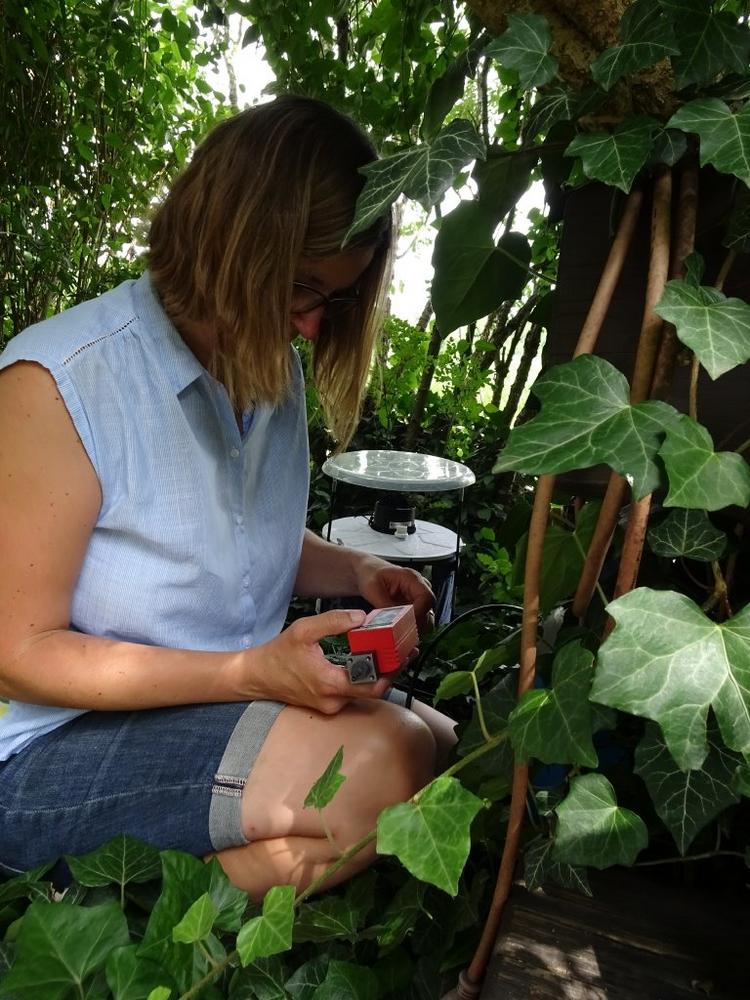
Contrary to popular belief, mosquitoes are not attracted to us because of "sweet blood." Rather, mosquitoes detect humans, especially in the dark, through their breath and skin scents. They are particularly sensitive to carbon dioxide (CO₂), a natural component of the air exhaled by all vertebrates. Before Biogents PLC was founded, its founders spent over 12 years researching the host-finding behavior of mosquitoes. Biogents applies this knowledge to develop traps that monitor and regulate mosquito populations. Carbon dioxide plays a key role in this process, as it is especially attractive to mosquitoes. People who emit more CO₂—such as pregnant women or individuals with a higher body weight—are particularly appealing to…
-
Mücken lieben CO2 – und wir lieben die CO2-Durchflussmessung
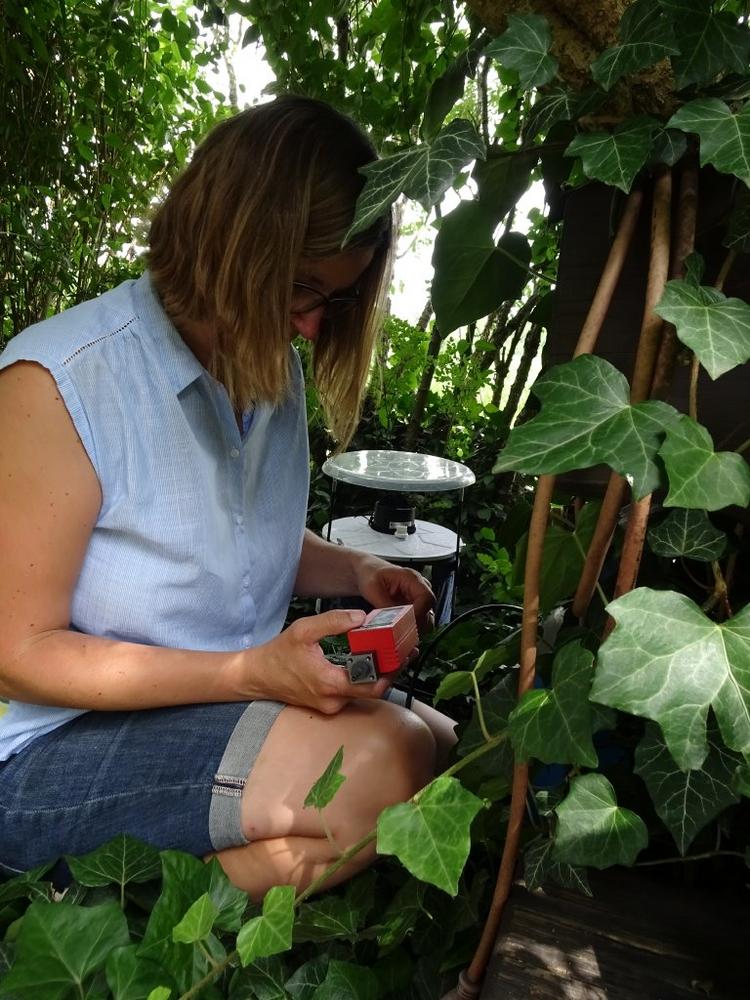
Ob Mücken uns attraktiv finden, hängt nicht vom „süssen Blut“ ab, wie oft behauptet wird. Vielmehr erkennen Stechmücken uns Menschen, insbesondere in der Dunkelheit, über den Atem und die Hautdüfte. Besonders empfindlich reagieren sie auf Kohlendioxid (CO2), dass ein natürlicher Bestandteil der Atemluft aller Wirbeltiere ist. Bevor die Firma Biogents AG ins Leben gerufen wurde, erforschten ihre Gründer über 12 Jahre lang das Wirtsfindungsverhalten von Stechmücken. Biogents nutzt dieses Wissen, um Fallen zu entwickeln, die Mückenpopulationen überwachen und regulieren zu können. Kohlendioxid spielt dabei eine Schlüsselrolle, da es Mücken besonders anzieht. Menschen, die mehr CO2 ausstossen – wie z.B. Schwangere oder Personen mit höherem Körpergewicht – wirken auf die Insekten…
-
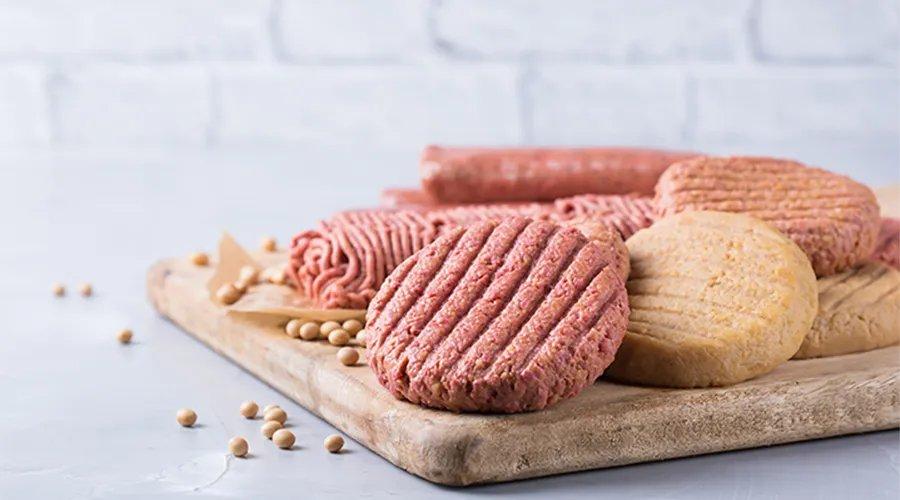
Revolution in food production
In the near future, bioreactors will have a lasting impact on food production. Especially in the production of cultured meat and plant-based alternatives, these innovative technologies open up completely new perspectives. Just as the introduction of smartphones revolutionised communication, bioreactors could fundamentally transform our view of food production and consumption. Sustainable innovation through bioreactors Cultured meat is produced by extracting animal cells and growing them in a culture medium under strictly controlled conditions in the bioreactor. These cells multiply and form muscle tissue, which is then processed into meat products – without the need for animal husbandry or slaughter. Challenges in organic production The success of this method depends largely…