
Blueleg, Colourleg, and Cave Midget: Nine New Spider Species Discovered
The limestone caves in Laos are among the most species-rich, and at the same time most sensitive, ecosystems in Southeast Asia: numerous specialized animal species, some of them exclusively found there, have evolved in the isolated karst landscapes, where they are perfectly adapted to darkness and nutrient-poor conditions. The cave systems thus act as important refuges for endangered species and play a key role for the country’s biodiversity. “Our regular research excursions to the region show how little we yet know about this cave diversity. Tourism and the extraction of limestone are threatening the species-rich fauna, which makes timely documentation all the more important,” explains Dr. Peter Jäger from the Senckenberg Research Institute and Natural History Museum in Frankfurt, and he continues, “In a new study, we have described a total of nine new spider species from the provinces of Vientiane, Khammouan, and Champasak and documented the spider family Ochyroceratidae for the first time in Laos.”
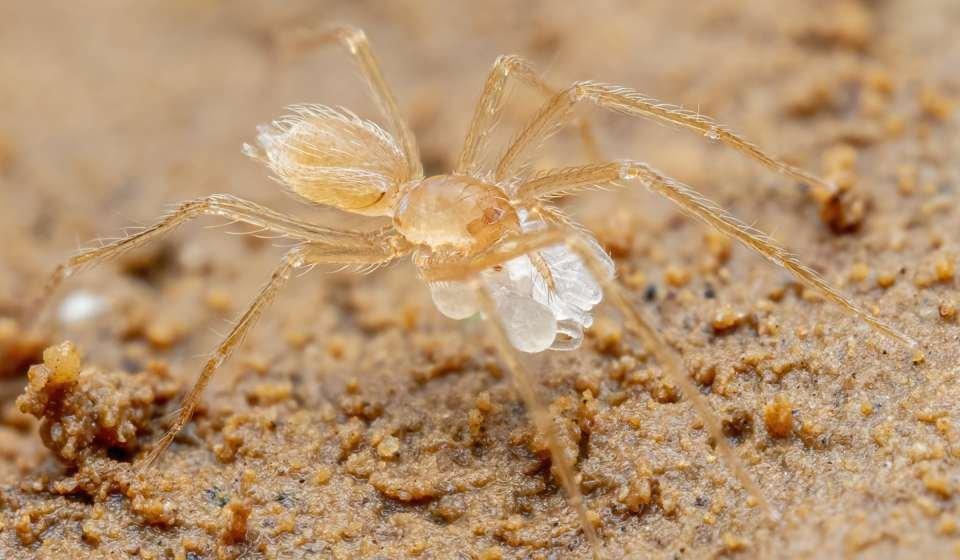
Together with his colleague Liphone Nophaseud from the National University of Laos, the Frankfurt arachnologist has conducted a detailed study of the spiders, which predominantly dwell in caves. “The spiders of the genus Speocera, which we have dubbed ‘cave midgets,’ are tiny spiders, only about one millimeter in size, which exhibit interesting brood care behavior. We discovered a female in her sheet web, which she had built in small cavities inside a stalagmite. There, she was carefully holding a single egg with her mouthparts. We believe this phenomenon may be due to the low availability of potential prey in the caves. This means that fewer but larger offspring have a better chance of surviving and establishing a new generation,” explains Jäger, and he continues, “We were able to observe another female carrying two already hatched spiderlings with her chelicerae. Amazingly, shortly after hatching the young animals were already almost half the size of their mother.” Species of the genus Sinoderces apparently also lay a greatly reduced number of eggs, following a similar strategy as the ‘cave midgets.’
Due to their colorful, iridescent legs, the research team from Laos and Germany suggests the colloquial names “Blueleg” for the genus Sinoderces and “Colourleg” for the species of the genus Althepus. “One of the new species – Sinoderces phoukham or the Phoukham Blueleg – is particularly remarkable as it is the first of the more than 220 species of the Psilodercidae family to lack eyes – a typical adaptation to life in caves,” adds Jäger. Sinoderces species all build extremely fragile webs that are destroyed by even slight air movements. This is why they only live under rocks or in caves – in other words, in habitats protected from the wind. According to the researchers, this considerably restricts the distribution of Sinoderces and could explain their strong regional limits. The home ranges of these endemic species are sometimes separated by no more than a few kilometers and, in some cases, are limited to just a single cave or cave system.
According to the study, it is still unclear why so many cave-adapted species occur in this particular region. The arachnologist from Frankfurt elaborates, “One possible explanation has to do with the climatic history of Laos. Around 50 million years ago, the uplift of the Himalayas led to climatic changes, resulting in the development of a pronounced dry season in Laos and neighboring countries. Species that preferred warm and humid conditions may have been forced to withdraw into caves, where they developed typical adaptations such as the loss of eyes or pigmentation.”
Because numerous species appear to have very limited ranges, the two researchers believe that many more species will likely be discovered in Laos in the future. “Our new descriptions emphasize the immense importance of the Laotian karst caves for species conservation – not only for spiders, but for other invertebrate groups as well,” adds Jäger in conclusion.
Senckenberg – Leibniz Institution for Biodiversity and Earth System Research // Senckenberg Gesellschaft für Naturforschung
Senckenberganlage 25
60325 Frankfurt
Telefon: +49 (69) 7542-0
Telefax: +49 (69) 746238
http://www.senckenberg.de
Pressestelle
Telefon: +49 (69) 7542-1434
E-Mail: pressestelle@senckenberg.de
Senckenberg Forschungsinstitut und Naturmuseum Frankfurt
Telefon: +49 (69) 7542-1340
E-Mail: peter.jaeger@senckenberg.de