Manual 3D model simplification isnt a process. Its a waste of resources.
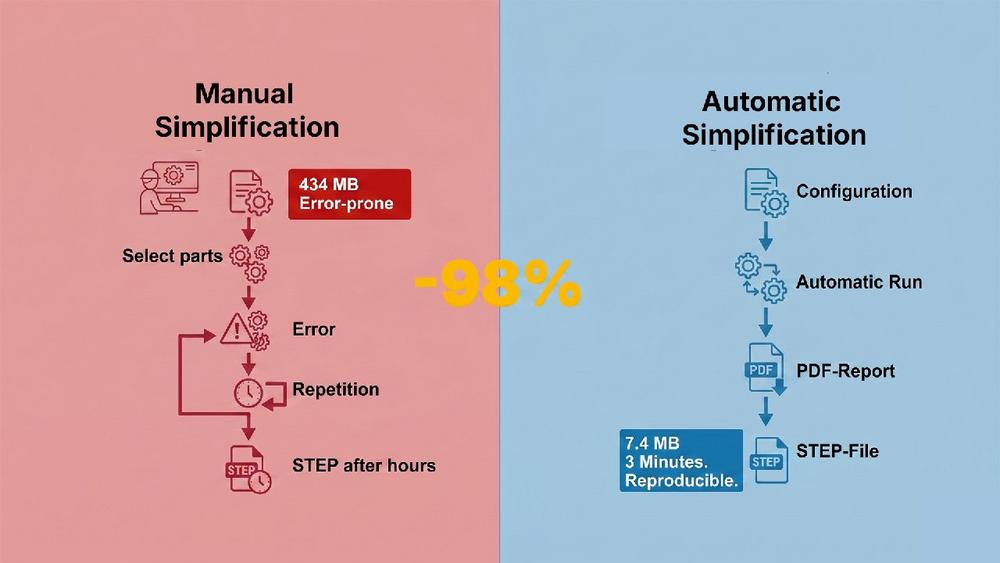
The 434 MB file isn’t the real problem. The problem is the process behind it: An engineer spends hours manually cleaning up an export model. He selects parts, deletes screws, and considers for each component whether it is externally visible or internal. That isn’t design work—it’s data maintenance.
For Schwingshandl – an Austrian manufacturer of custom machinery for lifting and conveying technology, with assemblies comprising up to 8,000 individual parts – this was exactly what their daily routine entailed: manually removing screws and internal components from STEP exports, assembly by assembly, a process that was error-prone and time-consuming.
What Changes When You Automate
Before – Manual
- Select and delete part by part
- No reproducible result
- Know-how not preserved in export
- 434 MB – barely transferable
After – Lino® Simplify
- Configured once, executed automatically
- Reproducible, logged in a PDF report
- Feature history removed → no reverse engineering
- 7,4 MB – ready to send in minutes
Lino® Simplify runs directly within the SolidWorks® CAD system – no separate tool, no file format conversion. The engineer configures the simplification rules once and saves them as an LSS file. All subsequent assemblies are processed automatically, from sketches through features and components to the final assembly.
Facts, no claims
- 97 % Max. reduction of default settings: 10 MB → 0.3 MB
- 92 % Hot wash cycle: 9.2 → 0.7 MB in 3 min
- 98 % Schwingshandl overall project: 434 → 7.4 MB
These values are not the result of compression, but rather of the deliberate removal of irrelevant geometry: toolbox components, holes, fillets, and weld surfaces. External dimensions remain unchanged. What is removed is unnecessary for the recipient—and, for reasons of trade secret protection, is none of their business.
Why this approach works, while others don’t
There are alternatives: manually cleaning up models, exporting only the outer shells, or providing customers with raw geometry. All three have the same flaw—they don’t scale or produce usable output. Lino® Simplify solves the scaling problem because configuration and process are separated: the rule is defined once, and the process can run as often as needed. That’s the difference between a workaround and a method.
Conclusion
3D model simplification is not a niche concern for those optimizing file sizes. It is a critical process for anyone who exchanges 3D data, plans layouts, or needs to protect intellectual property. Anyone who does this manually lacks a systematic approach—they have a gap in their process.
Die Lino Gruppe ist Anbieter technologieführender Software-Lösungen und von Beratungsleistungen für Design Automation, CAD-Daten-Generierung, CPQ, Systemintegration, 3D-Web-Visualisierung und 3D-Aufstellplanung. Unternehmen verschiedener Industriebranchen realisieren mit Lino Hub, Tacton CPQ, Cosling Configurator oder Tacton Design Automation durchgängige, effiziente Vertriebs- und Produktentstehungsprozesse mit großem Einsparpotenzial.
Lino 3D Konfigurationslösungen setzen neue Maßstäbe in der Produktkonfiguration; sie revolutionieren das Entwerfen, Konfigurieren und Verkaufen komplexer Industrieprodukte. Applikationen aus CAD, PDM, PLM, ERP, CRM, Web, eCommerce oder mobilen Endgeräten lassen sich unkompliziert integrieren.
Konfigurationsspezialist und Softwareentwickler Lino GmbH ist autorisierter Tacton Business Partner, Cosling Partner, SolidWorks Solution Partner, Microsoft Solution Partner und Mitglied im Autodesk Developer Network (ADN). Lino ist an sieben Standorten in Deutschland, Österreich und der Schweiz vertreten.
www.lino.de
www.youtube.com/user/LinoGmbH
www.linkedin.com/company/lino-gmbh
Lino ist ein eingetragenes Warenzeichen der Lino GmbH. Alle anderen Marken und Produktbezeichnungen sind Warenzeichen oder eingetragene Warenzeichen der jeweiligen Rechtsinhaber. © 2026 Lino GmbH
Lino GmbH
Große Bleiche 15
55116 Mainz
Telefon: +49 (6131) 32785-10
Telefax: +49 (6131) 32785-11
https://www.lino.de
Marketingleiter
Telefon: +49 (6131) 32785-15
E-Mail: kilian@lino.de


Das könnte dich ebenfalls interessieren

Kosten senken und Nachhaltigkeit fördern: Behälterkreisläufe mit COSYS digital steuern

CARI: Wo Technik auf Menschlickeit trifft – twinC zeigt, wie Innovation Integration möglich macht