Gold X2 Announces Positive Reconciliation in Main Zone Grade Control Drilling with Intercepts Including 49.0m of 2.13 g/t Au
Michael Henrichsen, CEO of Gold X2 commented, "We took the proactive step to derisk the resource model by conducting close-spaced drilling that emulates grade control drilling in a producing mine, to ensure we have a thorough understanding of the distribution of the gold mineralized shears at the mine scale. We have conducted a reconciliation exercise to understand how the resource model will perform in a potential mining scenario, and the results are very encouraging. Grade control drilling has identified additional, previously unrecognized secondary shear zones that have been assigned as waste in the current resource model. From this, we expect the upcoming infill drill program, with a tighter drill spacing, to grow the resource and significantly enhance the project’s overall economics and mine plan."
Highlights
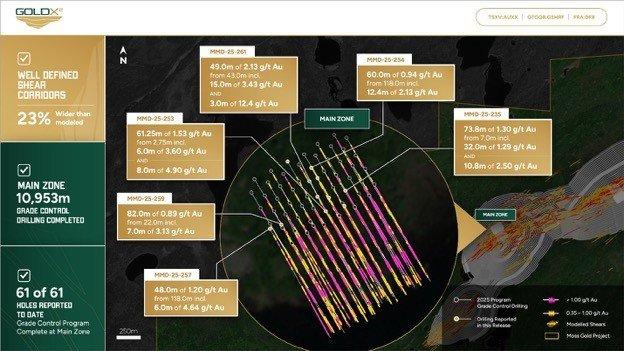
• Assay results from the final eleven holes in the Main Zone grade control drill program continue to strengthen confidence in the continuity of wide, near-surface, high-grade shear corridors defining the center of the Moss Main Zone. Select drill intercepts include:
o 73.8m of 1.30 g/t Au from 7.0m in MMD-25-235, including
▪ 32.0m of 1.29 g/t Au from 31.0m, and
▪ 10.8m of 2.50 g/t Au from 69.0m
o 61.25m of 1.53 g/t Au from 2.75m in MMD-25-253, including
▪ 6m of 3.60 g/t Au from 23m, and
▪ 8m of 4.90 g/t Au from 35m
o 60.0m of 0.94 g/t Au from 118.0m in MMD-25-254, including
▪ 12.4m of 2.13 g/t Au from 119.0m
o 48.0m of 1.20 g/t Au from 118.0m in MMD-25-257, including
▪ 6.0m of 4.64 g/t Au from 154.0m
o 82.0m of 0.89 g/t Au from 22.0m in MMD-25-259, including
▪ 7.0m of 3.13 g/t Au from 48.0m
o 49.0m of 2.13 g/t Au from 43.0m in MMD-25-261, including
▪ 15.0m of 3.43 g/t Au from 49.0m, and
▪ 3.0m of 12.4 g/t Au from 71.0m
• Reconciliation of all drill intercepts against those predicted by the current resource model shows 23% more and/or wider shears with an 8% drop in grade, which demonstrates the potential for positive implications for future resource models. Specifically, the reconciliation shows that there are additional low-grade secondary shears that have not been included in the resource model because of the wider spacing of the exploration drill holes.
Technical Overview
The results of the current grade control drill program are illustrated in the following figures and tables. Figure 1 shows the location map of the drill holes reported in this release, relative to the Moss Main grade control drill program. Figure 2 provides a cross-section of drill holes MMD-25-232, MMD-25-253, MMD-25-260, and MMD-25-261 representing the third easternmost section of the pattern. The results are summarized in Tables 1-1, which include significant intercepts (Table 1), drill hole locations (Table 2) and the reconciliation between actual drill intercepts and those predicted by the current resource model (Table 3).
Gold X2 designed two grade control drilling programs that have been drilled on a 12.5-meter diamond-shaped pattern:
• The Main Zone pattern covers a volume that is approximately 110 meters along strike, 70 meters across strike and 90-160 meters vertical depth. This program was completed with 61 drillholes (10,953m) and all assays have been received.
• The QES Zone pattern covers a volume that is 100 meters along strike, 70 meters across strike and 100-170 meters vertical depth. The program was completed with 58 drillholes (11,004m) with assays pending.
Both programs aimed to investigate the short distance behaviour of gold mineralization, informing the determination of the optimal drill spacing required to upgrade Inferred Mineral Resources to Indicated Mineral Resources in preparation for the upcoming Feasibility-level infill program. Additionally, the remaining half core will supply the required volume of sample for the upcoming Feasibility-level metallurgical studies. Finally, the tight spaced drilling provides mining-level precision that will derisk the Mineral Resource Estimate through a reconciliation analysis.
The results from the Main Zone pattern have supported the transition from modelling individual shear zones to shear corridors. Higher grade anastomosing shears can be traced within well-defined shear corridors that host a series of interweaving primary and secondary shears. Defining these mineralization-controlling features will allow for increased confidence in resource estimation, leading to an increased volume of Indicated blocks, and optimization of the infill drill program. The wider shear corridors will also improve mine design scenarios through optimizing the mining block size, fleet selection and mine dilution expectations.
The geological model created over the Main Zone grade control pattern confirms the preference for mineralization to occur within diorite-granodiorite intrusions. Shears are parallel to sub-parallel to intrusion contacts, but do not show any measurable difference in gold mineralization where they cross intrusion contacts. Shear intensity within intrusions correlates well with gold grades with higher intensity shearing returning higher gold grades. However, there is a significant decrease in gold mineralization where marginal shears cross into a wedge of dacitic volcanic wall rocks in the northern portion of the pattern. This is despite the dacite being locally intensely sheared.
Sericite, silica, albite and hematite alteration types have a modest positive correlation with gold mineralization, but this may be more a function of the diorite host rocks being preferentially altered by these assemblages. Chlorite and carbonate alteration occurs pervasively through the system showing no correlation with the gold mineralization. Epidote alteration, on the other hand, has a consistent negative correlation with gold mineralization within all phases of diorite. The development of an epidote alteration model will be considered for inclusion in future geological models.
Assay results for the entire 61-hole Main Zone grade control pattern have been compared against expected intercepts from the current resource model (Table 3). The total combined intercept lengths from grade control drilling are 23% larger than is expected from the resource model, while the average grade is 8% lower. This reflects additional lower-grade secondary shears that have not been well defined by drilling on the exploration spacing of 50 meters and therefore not modelled. This has the potential for an overall positive impact of reducing the volume of blocks modelled as waste, while adding potentially ore-grade blocks.
The current Moss Gold Project Mineral Resource was announced on January 26, 2026. The details will be provided in a technical report, prepared in accordance with NI 43-101 standards, to be filed before March 12, 2026 under the Company’s SEDAR+ profile.
Grant of Stock Options and Restricted Share Units
The Company also wishes to announce that, pursuant to the Company’s omnibus incentive plan, it granted a total of 2,925,000 stock options (the “Options”) and 2,815,000 restricted share units (the “RSUs”) to a director and consultants of the Company. The Options are each exercisable to purchase one common share of the Company (a “Common Share”) at an exercise price of $1.19 for a period of five (5) years. Each RSU entitles the holder to be issued one Common Share of the Company upon vesting, the RSUs will vest one year from grant.
Analytical and QA/QC Procedures
The HQ diameter drill core has been oriented using ACTIII or equivalent tools and validated in the core shack. All core has been sawed in half cut just off the core orientation line (bottom of hole) with the right half (looking down hole) of the core bagged and sent a third-party analytical laboratory. The left half of the core was returned to core boxes and is stored at Gold X2’s Kashabowie core yard facility.
All samples were sent to ALS Geochemistry in Thunder Bay for preparation and analysis was performed in the ALS Vancouver analytical facility. ALS is accredited by the Standards Council of Canada (SCC) for the Accreditation of Mineral Analysis Testing Laboratories and CAN-P-4E ISO/IEC 17025. Samples were analysed for gold via fire assay with an AA finish (“Au-AA23”) and 48 pathfinder elements via ICP-MS after four-acid digestion (“ME-MS61”). Samples that assayed over 10 ppm Au were re-run via fire assay with a gravimetric finish (“Au-GRA21”).
In addition to ALS quality assurance / quality control (“QA/QC”) protocols, Gold X2 has implemented a quality control program for all samples collected through the drilling program. The quality control program was designed by a qualified and independent third party, with a focus on the quality of analytical results for gold. Analytical results are received, imported to our secure on-line database and evaluated to meet our established guidelines to ensure that all sample batches pass industry best practice for analytical quality control. Certified reference materials are considered acceptable if values returned are within three standard deviations of the certified value reported by the manufacture of the material. In addition to the certified reference material, certified blank material is included in the sample stream to monitor contamination during sample preparation. Blank material results are assessed based on the returned gold result being less than ten times the quoted lower detection limit of the analytical method. The results of the on-going analytical quality control program are evaluated and reported to Gold X2 by Orix Geoscience Inc.
Qualified Person
Peter Flindell, PGeo, MAusIMM, MAIG, Vice-President, Exploration, of the Company, and a qualified person under National Instrument 43-101 – Standards of Disclosure for Mineral Projects, has approved the scientific and technical information contained in this news release.
Mr. Flindell has verified the data disclosed. To verify the information related to the winter drill program at the Moss Gold Project, Mr. Flindell has visited the property several times; discussed and reviewed logging, sampling, bulk density, core cutting and sample shipping processes with responsible site staff; discussed and reviewed assay and QA/QC results with responsible personnel; and reviewed supporting documentation, including drill hole location and orientation and significant assay interval calculations. He has also overseen the Company’s health and safety policies in the field to ensure full compliance, and consulted with the Project’s host indigenous communities on the planning and implementation of the drill program, particularly with respect to its impact on the environment and the Company’s remediation protocols.
About Gold X2 Mining
Gold X2 is a growth-oriented gold company focused on delivering long-term shareholder and stakeholder value through the acquisition and advancement of primary gold assets in tier-one jurisdictions. It is led by the ex-global head of structural geology for the world’s largest gold company and backed by one of Canada’s pre-eminent private equity firms. The Company’s current focus is the advanced stage 100% owned Moss Gold Project which is positioned in Ontario, Canada, with direct access from the Trans-Canada Highway, hydroelectric power near site, supportive local communities and skilled workforce. The Company has invested over $100 million of new capital and completed approximately 100,000 meters of drilling on the Moss Gold Project, which, in aggregate, has had over 300,000 meters of drilling. The 2026 updated NI 43-101 mineral resource estimate (“MRE”) for the Moss and East Coldstream Deposits has expanded to 2.458 million ounces of Indicated gold resources at 1.04 g/t Au, contained within 73.8 million tonnes and 4.209 million ounces of Inferred gold resources at 0.97 g/t Au contained within 134.7 million tonnes. The Moss Deposit also has a silver MRE of 3.160 million ounces of indicated silver resources at 1.53 g/t Ag contained within 64.3 Mt and 6.273 million ounces of inferred silver resources at 1.55 g/t Ag contained within 125.9 Mt. Results of a preliminary economic assessment (“PEA”) of the Moss Gold Project suggest the potential for the deposit to support a long-life mining operation with a strong production profile and low production costs. The MRE and PEA are supported by a NI 43-101 technical report for the Moss Gold Project which will be filed on SEDAR+ (www.sedarplus.ca) and the Company’s website by March 12, 2026. For more information, please visit SEDAR+ (www.sedarplus.ca) and the Company’s website (www.goldx2.com).
Neither the TSXV nor its Regulation Services Provider (as that term is defined in the policies of the TSXV) accepts responsibility for the adequacy or accuracy of this release.
Cautionary Note Regarding Forward-Looking Statements
This news release contains statements that constitute “forward-looking statements.” Such forward looking statements involve known and unknown risks, uncertainties and other factors that may cause the Company’s actual results, performance or achievements, or developments to differ materially from the anticipated results, performance or achievements expressed or implied by such forward-looking statements. Forward looking statements are statements that are not historical facts and are generally, but not always, identified by the words “expects,” “plans,” “anticipates,” “believes,” “intends,” “estimates,” “projects,” “potential” and similar expressions, or that events or conditions “will,” “would,” “may,” “could” or “should” occur. Forward-looking statements in this news release include, among others, statements relating to expectations regarding the exploration and development of the Moss Gold Project; the potential mineralization at the Moss Gold Project based on the winter drill program, including the potential for additional mineral resources; the enhancement of the Moss Gold Project; statements regarding the Company’s future drill plans, including the expected benefits and results thereof; that the Superion target has the potential to significantly add to the current mineral resource estimate within the top 200 meters from surface with continued drilling and to reduce the overall strip ratio of the deposit; the potential for resource growth at Moss and the fact that the results have the potential to significantly impact the economic performance of the deposit moving forward; the potential for a much larger mineralized system and that it will be pursued in the near future through additional drilling; and other statements that are not historical facts.
By their nature, forward-looking statements involve known and unknown risks, uncertainties and other factors which may cause our actual results, performance or achievements, or other future events, to be materially different from any future results, performance or achievements expressed or implied by such forward-looking statements. Such factors and risks include, among others: uncertainty and variation in the estimation of mineral resources; risks related to exploration, development, and operation activities; exploration and development of the Moss Gold Project will not be undertaken as anticipated; the Company may require additional financing from time to time in order to continue its operations which may not be available when needed or on acceptable terms and conditions acceptable; the economic performance of the deposit may not be consistent with management’s expectations; the Company’s exploration work may not deliver the results expected; the fluctuating price of gold; unknown liabilities in connection with acquisitions; compliance with extensive government regulation; delays in obtaining or failure to obtain governmental permits, or non-compliance with permits; environmental and other regulatory requirements; domestic and foreign laws and regulations could adversely affect the Company’s business and results of operations; risks related to natural disasters, terrorist acts, health crises, and other disruptions and dislocations; global financial conditions; uninsured risks; climate change risks; competition from other companies and individuals; conflicts of interest; risks related to compliance with anti-corruption laws; the Company’s limited operating history; intervention by non-governmental organizations; outside contractor risks; the stock markets have experienced volatility that often has been unrelated to the performance of companies and these fluctuations may adversely affect the price of the Company’s securities, regardless of its operating performance; the Superion target may not add to the current mineral resource; and other risks associated with executing the Company’s objectives and strategies as well as those risk factors discussed in the Company’s continuous disclosure documents filed under the Company’s SEDAR+ profile at www.sedarplus.ca.
The forward-looking information in this news release is based on management’s reasonable expectations and assumptions as of the date of this news release. Certain material assumptions regarding such forward-looking statements were made, including without limitation, assumptions regarding: the future price of gold; anticipated costs and the Company’s ability to fund its programs; the Company’s ability to carry on exploration, development and mining activities; prices for energy inputs, labour, materials, supplies and services; the timing and results of drilling programs; mineral resource estimates and the assumptions on which they are based; the discovery of mineral resources and mineral reserves on the Company’s mineral properties; the timely receipt of required approvals and permits; the costs of operating and exploration expenditures; the Company’s ability to operate in a safe, efficient, and effective manner; the Company’s ability to obtain financing as and when required and on reasonable terms; that the Company’s activities will be in accordance with the Company’s public statements and stated goals; that the Superion target will add to the current mineral resource; that the Company’s exploration work will deliver the results expected; and that there will be no material adverse change or disruptions affecting the Company or its properties.
The forward-looking information contained in this news release represents the expectations of the Company as of the date of this news release and, accordingly, is subject to change after such date. There can be no assurances that such statements will prove to be accurate and actual results and future events could differ materially from those anticipated in such statements. Readers should not place undue importance on forward-looking information and should not rely upon this information as of any other date. The Company undertakes no obligation to update these forward-looking statements in the event that management’s beliefs, estimates or opinions, or other factors, should change.
Swiss Resource Capital AG
Poststrasse 1
CH9100 Herisau
Telefon: +41764802584
Telefax: +41 (71) 560-4271
http://www.resource-capital.ch
Telefon: +41 (71) 354-8501
E-Mail: mo@resource-capital.ch


Das könnte dich ebenfalls interessieren

Newmont nach Zahlen im Aufwind
Elmos Semiconductor SE: Erfreuliche Auftragsentwicklung und starker Free Cashflow im dritten Quartal 2025 – Free Cashflow Prognose für das Gesamtjahr erhöht