Freedom of Choice: New Opel Astra as Battery-electric Astra Electric, Plug-in Hybrid, Hybrid or Efficient Diesel
- Additional range: New Astra Electric with a range of up to 454 kilometres (WLTP1)
- Practical innovation: Battery-electric Astra with V2L – Vehicle to Load – for the first time
- Further development: Plug-in hybrid also with more electric range
- Spoilt for choice: Broad Astra drive portfolio meets all needs
Combined values for Opel Astra Electric and Astra Sports Tourer Electric according to WLTP2: Energy consumption 15.3-15.8 kWh/100 km, CO2 emissions 0 g/km; CO2 label: A
Combined values for Opel Astra Plug-in-Hybrid and Opel Astra Sports Tourer Plug-in-Hybrid according to WLTP2: Energy consumption weighted 12.6-13.0 kWh electricity/100 km plus 2.2-2.3 l gasoline/100 km; CO2 emissions 49-53 g/km; CO2 class B. When the battery is empty: Fuel consumption 5.4-5.6 l/100 km; CO2 label D
Combined values for Opel Astra Hybrid and Astra Sports Tourer Hybrid according to WLTP2: Fuel consumption 4.9-5.1 l/100 km, CO2 emissions 109-114 g/km; CO2 label: C
Combined values for Opel Astra 1.5 Diesel and Astra Sports Tourer 1.5 Diesel according to WLTP2: Fuel consumption 4.9-5.1 l/100 km, CO2 emissions 130-134 g/km; CO2 label: D
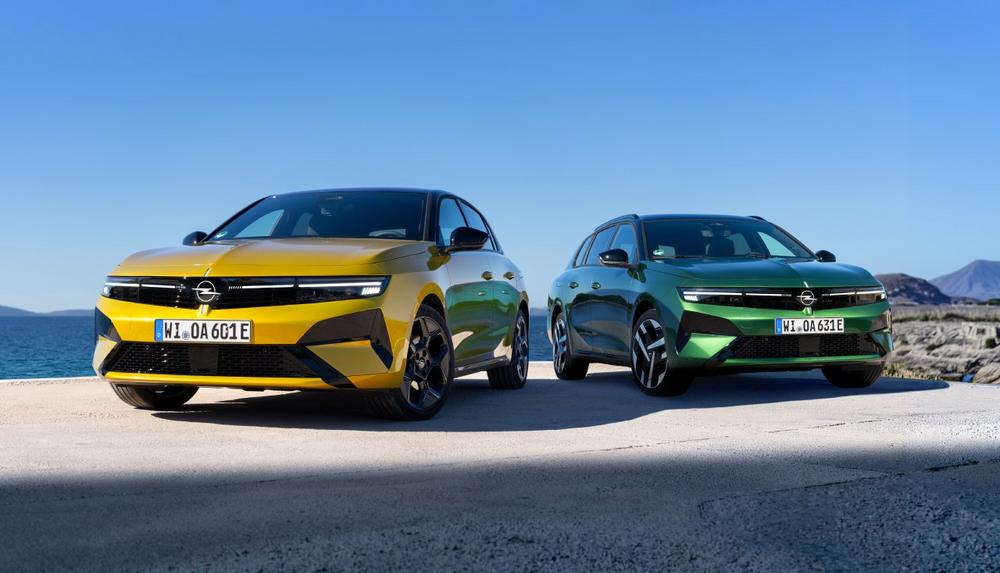
The new Opel Astra is crisper, bolder and more dynamic than ever – and its electrified versions can now cover longer distances. The new Astra Electric, for example, now enables up to 454 kilometres (according to WLTP1) between individual charging stops. The same applies to the plug-in hybrid. The drivetrain has also been further developed so that the purely electric and thus locally emissions-free range could be increased – according to EAER City to up to more than 100 kilometres (WLTP1). In addition, Opel offers a broad range of drive systems. This means that customers can also choose from efficient hybrid and diesel alternatives – tailor-made for all needs and every application.
Extended locally emissions-free range: Now up to 454 km (WLTP1) in Astra Electric
Resource conservation was the focus of the further development of the electrified Astra drive portfolio. The 115 kW (156 hp) Astra Electric with a 58 kWh battery (55 kWh usable capacity) and thanks to further aerodynamic fine-tuning now enables a locally emissions-free range of up to 454 kilometres (WLTP1) – allowing Astra Electric drivers to travel around 35 kilometres further than before until the first charging stop. The battery-electric car has just demonstrated how efficient it is, even under tough conditions, at the recent international dynamic launch. This means that the all-electric compact class bestseller offers driving pleasure with responsibility. It accelerates from 0 to 100 km/h in just 9.3 seconds (Sports Tourer: 9.5 seconds) while the top speed is electronically limited to 170 km/h. Furthermore, the maximum torque of 270 Newton metres, available from the first touch of the pedal, adds to the driving pleasure.
The regenerative braking system, now adjustable in 3 levels by the steering wheel paddle, also ensures that Astra Electric and Astra Sports Tourer Electric can recover energy while driving. And when the battery-electric Astra needs recharging, only a moderate stop at a 100 kW DC fast-charging station is required. There, the battery can be charged from 20 to 80 per cent state-of-charge in around 32 minutes3. In addition, every all-electric Astra comes with a bidirectional three-phase 11 kW onboard charger for fast AC charging at the home wall box as standard.
Elsewhere, the all-electric Astra offers V2L – Vehicle to Load – and thus the possibility of charging external devices such as e-bikes or the like at the holiday destination without having to rely on other power sources for the first time. Furthermore, the Astra Electric’s and Astra Sports Tourer Electric’s battery can be pre-conditioned in order to optimise any planned fast-charging sessions.
The best of both worlds: The electrified Astra Plug-in Hybrid and Astra Hybrid
Those who are not yet ready or able to make the switch to a fully electric vehicle can still enjoy the new Astra as an electrified hybrid or a further developed plug-in hybrid. With a system output of 144 kW (196 hp) and up to 360 Newton metres of torque, the latter represents the current peak performance in the Astra drive portfolio. The exemplary interaction of the combustion engine and electric motor together with the new electrified seven-speed dual-clutch transmission ensures balanced performance. The 1.6-liter four-cylinder engine produces 110 kW (150 hp). The electric motor now contributes up to 92 kW (125 hp). For locally emissions-free operation in city traffic, the driver can select the electric mode. Then the plug-in hybrid with a battery of 17 kWh (14 kWh usable capacity) now instead of 12.4 kWh can cover up to 84 kilometres purely electrically in accordance with WLTP1 – meaning that the new Astra Plug-in Hybrid offers almost 20 kilometres more of locally emissions-free range than its predecessor. Measured using the EAER City cycle, the car can now travel even up to 101 kilometres (WLTP1) purely electrically in urban areas. In addition, sporty acceleration and top speed are also guaranteed. From a standstill, the Astra five-door accelerates to 100 km/h in 7.6 seconds (Astra Sports Tourer Plug-in Hybrid: 7.7 seconds); a top speed of 225 km/h is possible (135 km/h purely electric).
Electrified driving and saving fuel at the same time without having to change driving and operating habits or connect the car to a charging point is offered by the Opel Astra Hybrid. The drive system includes a lithium-ion battery that charges automatically under certain driving conditions, as well as a 100 kW (136 hp) turbocharged petrol engine that works in combination with an electrified six-speed dual-clutch transmission and a 15.6 kW (21 hp) electric motor. The compact hybrid technology with a system output of 107 kW (145 hp) offers many advantages as a clever and cost-efficient solution in everyday operation – especially in city traffic.
The electric drive supports the petrol engine when accelerating as well as when starting from a standstill. Especially at low engine speeds of the combustion engine, the electric motor contributes torque, which benefits driving dynamics and CO2 savings. At low speeds, the electric motor also enables all-electric driving up to one kilometre or up to 50 per cent of the time used in the city. If the Astra Hybrid decelerates at higher speeds and the petrol engine shuts down, the electric motor acts as a generator to recharge the battery of the hybrid system. The optimally coordinated system is designed for the best performance at all times with the lowest energy consumption. In addition to the usual information, the fully digital driver information display shows further details about electrified operation.
Customers who prefer classic engine technology can choose the efficient 1.5-litre diesel coming with eight speed automatic as standard. The 96 kW (130 hp) four-cylinder engine accelerates both the Astra and Astra Sports Tourer to 100 km/h in 10.6 seconds and offers maximum torque of 300 Newton metres. Top speed is reached at 209 km/h.
With the wide range of powertrains including battery-electric, plug-in hybrid, hybrid and diesel, Opel continues to offer customers the choice of which drivetrain is best suited to their needs.
[1] The stated range was determined using the WLTP test procedures (Regulation (EC) No. 715/2007 and Regulation (EU) No. 2017/1151). The actual range may vary under everyday conditions and depends on various factors, in particular personal driving style, route conditions, outside temperature, use of heating and air conditioning as well as thermal preconditioning.
[2] A vehicle’s values not only depend on the vehicle’s efficient use of fuel, but are also influenced by driving behaviour and other non-technical factors.
[3] Charging power and charging time are influenced by a number of factors and may vary depending on, amongst other things, the type and power output of the charging station, the outside temperature, the battery temperature, the battery’s state of charge and condition, the vehicle’s specifications, and the vehicle’s settings.
Opel Automobile GmbH
Bahnhofsplatz 1
65423 Rüsselsheim
Telefon: +49 (6142) 7-70
Telefax: +49 (6142) 77-8409
http://de-media.opel.com/de
Telefon: +49 (6142) 6921679
E-Mail: matthias.meyer@opel-vauxhall.com
Communications, Manager International Product
Telefon: +49 (6142) 69-22084
E-Mail: colin.yong@stellantis.com