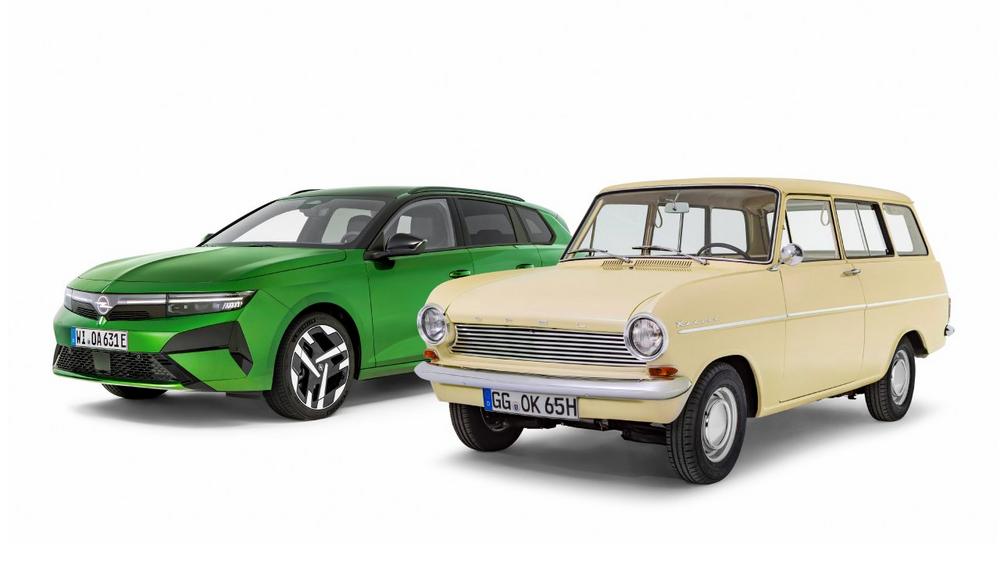
Spacious by Nature: From the First Opel Kadett Caravan to the New Opel Astra Sports Tourer
- As spacious as a bus: In 1963, the first Kadett Caravan revolutionised the compact class
- From Kadett Caravan to Astra Sports Tourer: Compact class bestsellers and pioneers of innovation from generation to generation
- New Astra Sports Tourer: Top technologies and comfort features, wide drive portfolio, and up to 1,634 litres of luggage space
Combined values for Opel Astra Sports Tourer Electric according to WLTP1: Energy consumption 15.6-15.8 kWh/100 km, CO2 emissions 0 g/km; CO2 label: A
Combined values for Opel Astra Sports Tourer Plug-in-Hybrid according to WLTP1: Energy consumption weighted 12.8-13.0 kWh electricity/100 km plus 2.3 l gasoline/100 km; CO2 emissions 51-53 g/km; CO2 class B. When the battery is empty: Fuel consumption 5.5-5.6 l/100 km; CO2 label D
Combined values for Opel Astra Sports Tourer Hybrid according to WLTP1: Fuel consumption 5.0-5.1 l/100 km, CO2 emissions 112-114 g/km; CO2 label: C
Combined values for Opel Astra Sports Tourer 1.5 Diesel according to WLTP1: Fuel consumption 5.0-5.1 l/100 km, CO2 emissions 132-134 g/km; CO2 label: D
Emotional design, clever technologies, maximum efficiency and, above all, proven practicality: the new Opel Astra Sports Tourer is ‘made in Germany’ through and through and impresses with its multiple qualities. The innovations range from the latest generation of adaptive Intelli-Lux HD lighting technology and standard Intelli-Seats to a wide choice of drive systems that meet every need. However, an Astra Sports Tourer would not be a true Opel estate if it did not demonstrate its proven strengths as a flexible load master. Thus, it shines with a variable luggage compartment and a boot capacity of up to 1,634 litres.
This practicality has always been a hallmark of Opel’s compact class cars. The new Astra Sports Tourer is the latest in a long line of bestsellers in this important segment that are as practical as they are comfortable. Everything started with the Kadett A Caravan. In 1963, Opel presented its first compact class estate and quickly became the market leader in this segment. From that day on a car with the practicality of a van – i.e. a car a van – has been part of every new Kadett and Astra generation. And as estates have increasingly evolved over the decades from typical workhorses for tradesmen into practical lifestyle companions, every ‘extended’ Astra has carried ‘Sports Tourer’ in its name since 2010.
Three in one: In 1963, the Opel Kadett A Caravan is launched
The Opel Kadett Caravan revolutionised the compact class in 1963. The estate, initially launched as the ‘Caravan 1000’, was the first of its kind to be designed for both the transportation of passengers as well as goods. A large boot and plenty of room for up to six people thanks to a third row of seats (four adults and two children) plus a new, lively engine and low maintenance costs made up the recipe for success for the Kadett A Caravan which was 3.92 metres long and 1.48 metres wide.
In the words of the Opel executives at the time: “The bodywork is designed to accommodate a large load compartment, which can be accessed via a tailgate that opens upwards from the rear panel. This convenient access makes loading and unloading easy. The rear bench seat can be folded down, extending the load compartment to a length of 1.5 metres.” This made the boot more than just a standard luggage compartment; even a fridge could be transported in the car. Neither of these features was a given back then. Both the tailgate, which swung upwards for easier access to the rear and served as rain protection in bad weather, for example, and the fold-down rear bench represented innovations and demonstrated how Opel was already balancing practicality with comfort for its customers in those days. The amount of space inside amazed drivers of previous small cars – the Kadett Caravan thus proved itself to be the ideal family, holiday and work vehicle all in one.
Meanwhile, the contours of the estate were businesslike and modern. The beltline was low down, the panoramic windows – stretching across a total of around two square metres according to the advertising leaflet from that time – ensured good visibility and a decorative strip running along the side accentuated the stretched form. Front fenders tapered off into the headlamps. And as early as in the 1960s, a distinctive design feature could be seen in the centre of the bonnet: a subtle crease running towards the radiator grille.
Another feature of the Kadett Caravan that was both practical and enhanced passengers’ comfort: the fuel tank cap was outside. “Opel Kadett, in brief: O.K.,” wrote Opel’s advertising team, unable to also resist a dig at their competitors in Wolfsburg. “You never have the smell of petrol in the trunk,” they said with a wink. And with its modern, water-cooled front engine, the Kadett had another major design advantage over the Beetle. The 993-cc four-cylinder unit developed a lively 40 hp. Thanks to this formula, the first Kadett Caravan became a bestseller. It was produced until 1965 and laid the foundations for the continued success of all subsequent compact class bestsellers from Rüsselsheim.
Innovative everyday hero with transport qualities: The new Opel Astra Sports Tourer
Today, the new Opel Astra Sports Tourer represents the latest evolution of the compact class bestseller ‘made in Germany’ – designed, developed and built at Opel’s headquarters in Rüsselsheim. Of course, once again the now 4.64 metres long and 1.86 metres wide (with mirrors folded) spacious estate focuses on practicality and flexibility. The Astra Sports Tourer thus shines as a true all-rounder for everyday life, work and leisure, combining sporty styling with transport qualities.
This is shown by the versatile boot. Depending on the variant, up to 1,634 litres of luggage fit into the rear compartment. Not only numerous suitcases and work utensils, but also more voluminous items such as transport boxes can be comfortably accommodated. At the same time, loading is pleasantly easy thanks to the around 60-centimetre low loading sill. And if skis or surfboards form part of the luggage, the rear seat backrest in the compact class estate can be folded down flexibly in a 40:20:40 ratio. Thus, the loading length increases to 1.85 metres.
Added to this are numerous innovative technologies, even greater comfort and even more character. The highlights of the new appearance include the illuminated Opel Blitz emblem on the front – a first for the Astra –, the adaptive, glare-free Intelli-Lux HD light and the standard Intelli-Seats with ergonomic recess. The developers and designers have remained true to Opel’s sustainability approach: the interior of the new Astra Sports Tourer features 100 per cent recycled materials.
Thus, the new Opel Astra Sports Tourer is crisper, more comfortable and resource-saving than before and can cover longer distances. The new Astra Sports Tourer Electric, for example, now enables up to 445 kilometres (according to WLTP2) between individual charging stops. The same applies to the plug-in hybrid. Its drivetrain has also been further developed so that the purely electric and thus locally emissions-free range could be increased – according to EAER City to up to more than 100 kilometres (WLTP2). In addition, Opel offers a broad range of drive systems. This means that customers can also choose from efficient hybrid and diesel alternatives – tailor-made for all needs and every application.
[1] A vehicle’s values not only depend on the vehicle’s efficient use of fuel, but are also influenced by driving behaviour and other non-technical factors.
[2] The stated range was determined using the WLTP test procedures (Regulation (EC) No. 715/2007 and Regulation (EU) No. 2017/1151). The actual range may vary under everyday conditions and depends on various factors, in particular personal driving style, route conditions, outside temperature, use of heating and air conditioning as well as thermal preconditioning.
Opel Automobile GmbH
Bahnhofsplatz 1
65423 Rüsselsheim
Telefon: +49 (6142) 7-70
Telefax: +49 (6142) 77-8409
http://de-media.opel.com/de
Telefon: +49 (6142) 6921679
E-Mail: matthias.meyer@opel-vauxhall.com
Communications, Group Manager International Product
Telefon: +49 (6142) 69-21574
E-Mail: martin.golka@stellantis.com
Telefon: +49 (6142) 6927466
E-Mail: leif.rohwedder@opel-vauxhall.com