Eleven Generations, One Castle: Architect Anna Philipp on the Future of Architecture as a Collector’s Piece
Ms Philipp, ten years at Waldenburg Castle as the seat of your practice – and yet Philipp Architekten is much older. Tell us the story.
Our practice is a family business now in at least its eleventh generation, so its history reaches far back, into a time when architecture was naturally understood as a craft and a life’s work rather than a service. What changed ten years ago was the place in which we work, not our attitude. We moved into Waldenburg Castle because we were looking for a setting that corresponded with the way we think and work: a place that breathes history while still thinking toward the future. One designs differently when surrounded by vaulted ceilings rather than suspended office tiles.
A castle as an office is unusual. Was that a deliberate statement?
Absolutely. We wanted a place that embodied our conviction before we even had to articulate it: that good architecture does not belong to the moment, but to time. When clients come to us to speak about their own life’s work – a house, a winery, a corporate seat meant to endure for generations – it helps when the setting itself already proves that such endurance is possible.
Who do you design for today? Who comes to see you here?
Our clientele has become international, and we were always open to that, even if we never pursued it as a strategy – it emerged from the work itself. We advise and design for clients from Germany and Switzerland, but increasingly also from across Europe and beyond. What connects them is less their origin than their attitude: they are connoisseurs. They are people who have seen a great deal – art, design, watches, architecture – and precisely for that reason they immediately recognize the difference between something that is merely well executed and something truly exceptional. A superficial rendering is not enough for this audience.
You often speak about architecture as a store of value. Does that align with what you see in the market?
Yes – though the true value rarely announces itself in figures. It reveals itself in character. Today’s buyers are no longer chasing square footage; they are chasing permanence – beauty, substance, an intelligence of material and proportion that cannot be faked. The houses that matter outlast fashion entirely. They are inhabited, loved, handed down through families – and, quietly, over time, they become what one might simply call a collector’s piece.
That sounds like what you call Collectible Architecture.
Exactly. In Paris, there is an agency, Architecture de Collection, which explicitly markets contemporary architect-designed houses as works of art – as collector’s pieces. I find the term apt because it names something we have practised for eleven generations without ever needing to call it that. A building with a clear signature, one that cannot be reproduced, one born of precise craftsmanship rather than catalogue logic – becomes a unique piece. And unique pieces do not lose value; they gain it.
Which architectural developments strike you as especially relevant right now?
Several lines are converging into a very clear picture. Craftsmanship is overtaking size – genuine handcraft is once again recognized and rewarded, while superficial upgrading no longer convinces. True craftsmanship is the new luxury. Character is overtaking square footage – smaller but atmospherically dense properties in exceptional settings are gaining ground. And we are seeing a form of warm minimalism: clean lines, but with texture, light and materiality that replace the cold white cube of recent years.
And what about the subject of wellbeing?
Wellness, yes – but to me that is far too narrow. What our clients are really looking for today is more than a beautiful spa area: it is a private hideaway in a time that has become relentlessly loud and hectic. A place where one can finally return to oneself. And there is another aspect I consider essential: a renaissance of beauty. Not in a superficial sense, but as a deeply felt quality – as harmony, as proportion, as an atmosphere that sustains.
From an architectural perspective, this creates a delicate balance that occupies us every day: rooms need to feel generous and open, yet never cold or impersonal. Generosity and intimacy – cosy, if you like – must be perceptible at the same time, not one after the other. One aspect that is often underestimated in this context is acoustics. I always tell our clients: you will not only see a room, you will hear it – and that is precisely where the question of true deep relaxation is decided. A material that absorbs sound instead of throwing it back, a ceiling that allows for silence instead of echo: these are the quiet decisions that ultimately determine whether a home becomes a true retreat or merely looks beautiful.
You often mention that architecture in your work never stands alone.
That is perhaps our greatest distinction from many other practices. We never think of architecture, interior design and landscape architecture separately, but as a curated total work of art. A building whose interior does not correspond with the architecture remains a fragment. A garden not developed out of the architectural concept remains decoration. Only when structure, interior design and landscape emerge from the same idea does one arrive at what our clients are really seeking: a place with one coherent signature.
One of the defining topics of our time is artificial intelligence. How do you view it?
It is a question that occupies us greatly in the office. Not long ago, my brother Christopher drew a comparison in an internal strategy address that has stayed with me ever since. He compared the current moment to the watch industry at the end of the 1970s, when the quartz watch emerged.
Tell us more.
The quartz crisis completely reshaped the watch market at the time. Industrially manufactured quartz watches were more precise, less expensive and scalable in mass production – and a large number of traditional manufactures were almost destroyed by that shift. But a few houses understood something that, in the end, saved the market: a mechanical watch is not merely a technical instrument for telling time. It is craft, history, soul – a collector’s piece. Out of that realization came haute horlogerie as we know it today, more valuable and more desirable than ever.
And the parallel to architecture?
To me it is obvious. AI will optimize floor plans, generate renderings in seconds and accelerate processes – that is unavoidable and, in many areas, even useful. But a building that emerges only from algorithms becomes the architectural equivalent of a quartz watch: functional, yet without soul. Our task as an architectural practice in its eleventh generation is to preserve precisely what no machine can replicate – signature, intuition, the decision born of experience and heart. That is our haute architecture, if you will. And I am convinced that in twenty years, these are the buildings that will stand where mechanical watches stand today: as the true collector’s pieces.
Finally, what do you wish for the next ten years at Waldenburg Castle – and for the twelfth generation?
Above all, I wish for beauty to regain an outstanding place in architecture. Not as mere surface, but as something essential – something that creates atmosphere, gives identity and moves people. This renaissance of beauty is, incidentally, something that is occupying me at the moment in the context of a book I am currently working on.
And yes: the twelfth generation is already ante portas. My two nephews, Otto and Karl Philipp, are already working on their first projects of their own. That fills me with joy because it makes continuity visible without allowing it to become stagnation. My wish is that, as a family, we preserve our unity – no matter what comes.
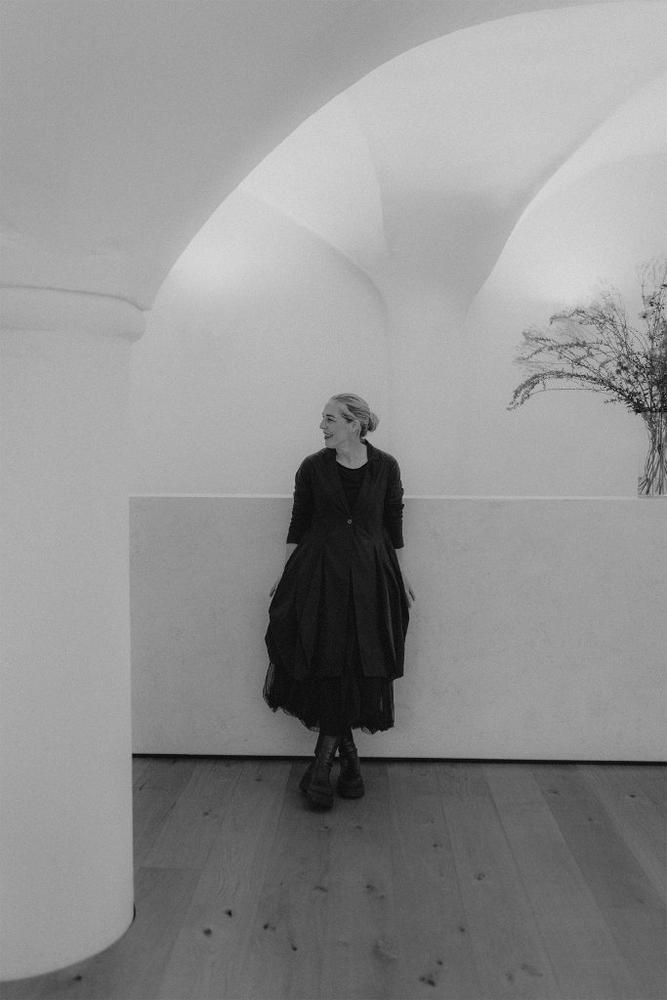
Anna Philipp and her internationally active team at Philipp Architekten specialise in bespoke, exclusive architecture conceived as a total work of art. The innovative concept of ‘Collectible Architecture’ transforms every project into a unique, collectable work of art.
Philipp Architekten GmbH
Schlossstrasse 16
74638 Waldenburg
Telefon: +49 791 75990
http://www.philipparchitekten.de
Referentin für Marketing und Öffentlichkeitsarbeit
Telefon: 0791759925
E-Mail: nk@philipparchitekten.de