-
Still Planning Facility Layouts on 2D Floor Plans? You Are Risking the Contract.
Yet many companies still deliver abstract 2D floor plans to their customers — plans that capture neither heights nor potential collisions. This is not an expression of efficiency. It is a structural competitive disadvantage — and it is fixable. The 2D Problem Is Not a Minor Issue A company that submits a facility layout based on a 2D sketch is not showing its customer what they are actually purchasing. Spatial bottlenecks, service access routes, overhead clearances — none of these are visible in a plan view. Decisions are made on incomplete data. Once installation begins, the surprises follow: mispositioned modules, clashes with building structures, missing access points. Reworking at that…
-
Drei Tage für eine Variante, die sich hätte automatisieren lassen: Warum manuelle Konstruktionsprozesse heute keine Option mehr sind
Das Problem hat einen Namen: repetitive Expertise Im Sondermaschinenbau, im Anlagenbau, überall dort, wo Kunden konfigurierbare Produkte bestellen, läuft täglich dasselbe Muster ab. Ein Ingenieur mit fünf oder zehn Jahren CAD-Erfahrung öffnet Autodesk Inventor, zieht Maße aus der Anforderungsliste, modelliert eine Variante, die sich zu 80 % aus bereits bekannten Parametern zusammensetzt – und fängt von vorn an. Nicht weil er keine Alternative hat. Sondern weil kein Prozess existiert, der seine Regeln trägt. Das Ergebnis: Durchlaufzeiten von zwei bis fünf Tagen pro Variante, Fehler beim manuellen Übertragen ins PDM-System und Konstruktionskapazität, die für Routineaufgaben verbrannt wird statt für Produktentwicklung. Das ist nicht übertrieben – das ist Alltag in Fertigungsunternehmen…
-
Three days to build a variant that a rule set could have generated in minutes. Why manual design processes are no longer defensible
The problem has a name: repetitive expertise In special-purpose machinery, in plant engineering, wherever customers order configurable products, the same pattern plays out every day. An engineer with five or ten years of CAD experience opens Autodesk Inventor, reads the requirements sheet, and builds a variant that draws on parameters he has seen dozens of times before. Then he starts again from scratch on the next one. Not because there is no better way. Because no process exists to carry his knowledge forward. The consequence is not dramatic. It is mundane, and that is precisely the problem. Lead times of two to five days per variant. Errors introduced when…
-
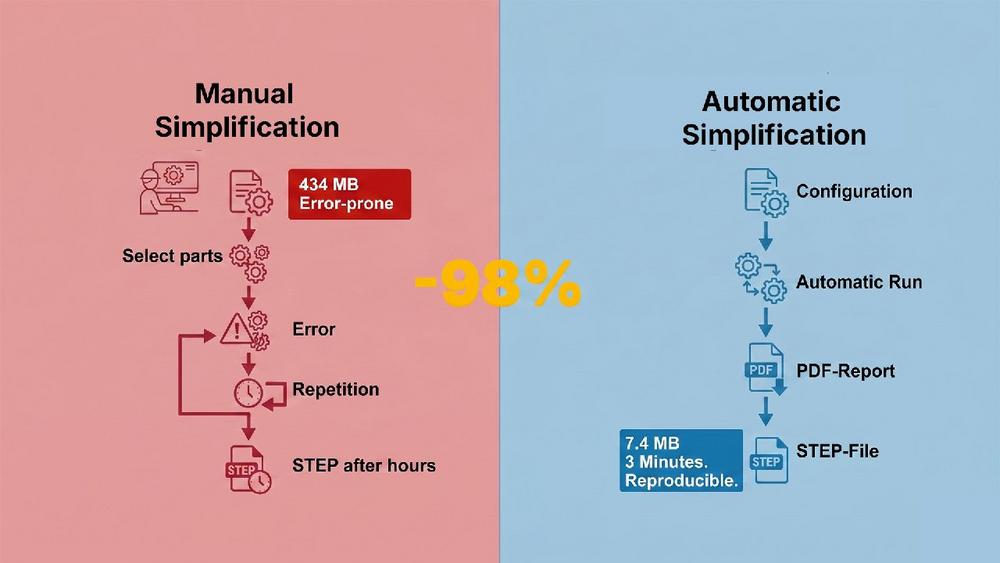
Manual 3D model simplification isnt a process. Its a waste of resources.
The problem runs deeper than the file size The 434 MB file isn’t the real problem. The problem is the process behind it: An engineer spends hours manually cleaning up an export model. He selects parts, deletes screws, and considers for each component whether it is externally visible or internal. That isn’t design work—it’s data maintenance. For Schwingshandl – an Austrian manufacturer of custom machinery for lifting and conveying technology, with assemblies comprising up to 8,000 individual parts – this was exactly what their daily routine entailed: manually removing screws and internal components from STEP exports, assembly by assembly, a process that was error-prone and time-consuming. What Changes When You…
-
Manuelle 3D-Modellvereinfachung ist kein Prozess. Es ist Ressourcenverschwendung.
Das Problem sitzt tiefer als die Dateigröße Nicht die 434-MB-Datei ist das eigentliche Problem. Das Problem ist der Prozess dahinter: Ein Ingenieur verbringt Stunden damit, ein Exportmodell manuell zu bereinigen. Er wählt Bauteile aus, löscht Schrauben, überlegt bei jeder Komponente, ob sie extern sichtbar oder intern ist. Das ist keine Konstruktionsarbeit – das ist Datenpflege. Manuelle Bereinigung skaliert nicht. Bei einer Baugruppe mag sie vertretbar sein. Bei zehn Baugruppen, wiederkehrenden Freigabeprozessen und wechselnden Lieferanten bricht dieser Ansatz zusammen. – Anas Tajouaout, Consultant bei der Lino GmbH Im Fall von Schwingshandel – österreichischer Sondermaschinenbauer für Hebe- und Fördertechnik, Baugruppen mit bis zu 8.000 Einzelteilen – war genau das der Alltag: Schrauben…
-
STEIN Automation: 3D layouts for customer proximity and modular flexibility
STEIN Automation GmbH has consistently digitized its installation planning and uses Lino® 3D layout, Lino® 2D fix, and Tacton® Design Automation for this purpose. Design errors are reduced, quotation processes are significantly accelerated, and customers benefit from realistic 3D layouts that enable quick approvals and a modern customer experience. The Black Forest-based specialist for modular transfer systems such as conveyor belts, transfer units, and centering devices has used software made by Lino® to digitize its installation planning, reduce the error rate, and take the customer experience to a new level. Planning complex systems in 2D is time-consuming and prone to errors—even for STEIN Automation. In addition, STEIN customers increasingly wanted…
-
STEIN Automation: 3D-Layouts für Kundennähe und modulare Flexibilität
Die STEIN Automation GmbH hat ihre Aufstellplanung konsequent digitalisiert und nutzt dazu Lino® 3D layout, Lino® 2D fix und Tacton® Design Automation. Fehler in der Konstruktion werden reduziert, Angebotsprozesse deutlich beschleunigt, und Kunden profitieren von realistischen 3D-Layouts, die schnelle Freigaben und ein modernes Kundenerlebnis ermöglichen. Der Schwarzwälder Spezialist für modulare Transfersysteme wie Transportbänder, Umsetzer und Zentriereinrichtungen hat mit Software Made by Lino® seine Aufstellplanung digitalisiert, die Fehlerquote gesenkt und die Kundenerfahrung auf ein neues Niveau gehoben. Komplexe Anlagen in 2D zu planen, ist zeitaufwendig und fehleranfällig – auch für STEIN Automation. Zudem wünschten sich die STEIN-Kunden zunehmend 3D-Visualisierungen, deren Erstellung viel Handarbeit erforderte. Eine zukunftsfähige Lösung fand das Unternehmen auf…
-
GC-heat: Schneller von der Anfrage zum Angebot dank Turbo-Produktkonfiguration und integrierter Add-Ons
GC-heat Gebhard GmbH & Co.KG, Spezialist für elektrische Heizsysteme, setzt auf Konfigurationslösungen von Tacton Systems und Lino GmbH. Ergebnis: Die Bearbeitungszeit zwischen Kundenanfrage und Angebot hat sich radikal reduziert, während gleichzeitig die Datenqualität weiter optimiert und die Prozesssicherheit erheblich gesteigert wurden. GC-heat fertigt individuelle Heizelemente für Branchen wie Verpackung, Chemie, Medizintechnik und Maschinenbau. Die Vielfalt der unterschiedlichsten geometrischen, mechanischen und elektronischen Eigenschaften umfasst Sonderanfertigungen von wenigen Gramm bis zu Einzelstücken von über 750 kg. Eine schwierige Situation für den Vertrieb, der bisher sehr auf persönliches Erfahrungswissen baute. Anforderungen wurden manuell erarbeitet, Berechnungen über selbstentwickelte Lösungen durchgeführt. Das war sehr zeitaufwendig – insbesondere bei zunehmender Produktkomplexität. Mit Software Made by Lino®,…
-
GC-heat: Faster from inquiry to quote thanks to turbo product configuration and integrated add-ons
GC-heat Gebhard GmbH & Co.KG, a specialist in electric heating systems, relies on configuration solutions from Tacton Systems and Lino GmbH. Result: processing time from customer inquiry to quotation has been radically reduced, while data quality has been further optimized and process reliability significantly increased. GC-heat manufactures customized heating elements for industries such as packaging, chemicals, medical technology and mechanical engineering. The wide variety of geometric, mechanical and electronic properties ranges from special components weighing just a few grams to individual units of more than 750 kilograms. This posed a challenge for sales, which previously depended heavily on personal expertise. Requirements were worked out manually, and calculations carried out with…
-
Lino GmbH advances nanosatellite serial production with digital configurator
Lino GmbH is a project partner in the FORnanoSatellites research cluster, a consortium of four scientific institutions and 14 industrial partners led by Friedrich-Alexander University Erlangen-Nuremberg. The aim is to research new technologies in order to promote the establishment of series production for nanosatellites in Bavaria in the long term. In July 2025, the Bavarian Transformation and Research Foundation provided almost 1.8 million euros in funding for the three-year project. For more than 18 years, Lino has been implementing innovative configuration and automation solutions for complex requirements in mechanical engineering/plant construction, such as in the packaging industry. Particularly noteworthy is the ability to work with industrial customers to quickly and…